This is another collection from recent meetings and trips. It works best
if you can find a native English speaker with exposure to corporate
America to elaborate on the finer points that I cannot cover well here.
* Everyone is welcome to weigh in on this issue. [Everyone is welcome to give his opinion on this issue.]
* Let's get a best guessmate or swag for these development tasks. [Let's get a best estimate for these development tasks.]
* To get that storage discovery code to work in a month is a nonstarter. [To get that storage discovery code to work in a month has little chance of success.]
* Please note that this is not fully
vetted within Adam's org. [Please note that this is not fully examined within Adam's organization yet.]
* I will be on the road and/or in the sticks, so if you need
to contact me, it may be hard. [I will be on the road and/or in the back country, so if you need to contact me, it may be hard.]
* The counter was also a diagnostic breadcrumb during development. [The counter was also a diagnostic left-over piece during development.]
* Yes, that project just got integrated was my day job :-). [Yes, that project just got integrated was my officially assigned regular day-time job :-)]
* I am currently maxed-out with support to customers. [I am currently completely swamped with supports to customers.]
* Feels like treading water now. [Feels like not making any progress now.]
* I'm feeling a little under the weather today. [I'm feeling ill today.]
* As part of on-boarding process, you'll learn this new tool. [As part of the process to join this new team, you'll learn this new tool.]
* Once you sign up for it, you'll be on a very slippery slope. [Once you agree to join it, you'll be on a very treacherous path.]
* You need to give security visibility to the development process. [You need to raise the awareness of security in the development process.]
Tuesday, June 18, 2013

Tuesday, March 5, 2013
Beekeeping Field Trip
On my bus rides to the Fragrant Hill for hiking, I saw bee hives stacked up along the bus route outside of Fourth Ring road in Beijing. I was quite curious about this outdoor setup. I had honey, walnut, milk, and oatmeal for breakfast routinely for years. I bought a copy of "Beekeeping for Dummies" to read in August 2008. It was fascinating to read. Bees are one of the oldest domesticated animals. Honey bees are quite docile, while wasps are not.
Anyway, on August 14, 2010, I paid my first visit to a bee supply outfit, Carrier's Bees in San Jose, which was very close to my Campbell home. I found it in an Internet search. It was good to see and touch the basic components of a modern movable Langstroth comb hive with explanations and tips from the friendly shop owner.
 I got a Livingsocial Roundrock Honey voucher as my birthday gift the summer of last year. Finally I managed to redeem it for a 3-hour class and demo in a place near Hunters Point, San Francisco before it expired.
The class took about an hour. It covered the basic honey bee society, the whole life cycle of a hive, the gears for beekeeping, the seasons, the flowers, and the climates. The honey bee society is a very centralized one. The one and only queen in the hundreds of thousands (at the peak of the season) bees in colony lives for 2 or more years. She is well fed, well attended, and her only job is to lay eggs around the clock. The picture on the left shows what queen's cell is like. The worker bees (sterile females) have a life cycle of 35 days or so. The drones (male bees) are only good for mating.
 This was the first class in this season. They could not do demos during cold and rainy winter days. The bees would be resting in the hive. We were lucky to have a nice sunny Saturday. The hives and boxes were very minimal, as the colonies kept only the minimum to get through the (short) winter in California. As the bees work and make honey to fill up the existing boxes and frames, new boxes will be added on top to allow for population growth and honey build-up. On the left, you see a box with all the frames inside.
 After our teacher cleaned up the propolis and beeswax a bit, frames were removed for show and tell and also for further cleaning. The cleaning job was relative simple and straightforward, because the season is just started.
 Starting up, the bees use the frames for both nursery and food store. The queen drops an egg in the cell. After three days, the nurse bees feed the larvae, first with royal jelly, and then soon wean them to regular food, that is, honey and pollen. Worker bees drop pollen and nectar into cells. Nectar ripens to honey after adding an enzyme and after some serious fanning by the bees to remove water content. Pollen is packed. Both honey and pollen are food for the colony.
 Now, I got hold of a frame that the combs are almost full, because bees are doing their final puking and touching on the cells. This is a busy society, and everyone knows what she and he is supposed to do.
 Many people react so stereotypically when they heard the bee word :-) I was happy to have Henry with me on this trip. By the end of class, there are enough people convinced that these bees are really docile. We took our hats and veils off for the picture. Unless we confront the bees directly and threaten them, we do not have anything to fear. Being on the cautious side is always a good idea though.

The last stop was the tasting of local pollens and honey. There were eucalyptus, lavender, wild flowers and other varieties. The honey was more expensive than what you can get in Costco. But, the taste was very distinct and unique. The mass-produced honey is more uniform and less exciting. Locally produced honey is good for people suffering from hay fever and pollen allergy. I suppose that is a vaccine-like effect, with people taking small doses of the same local pollen in their food.
There are only a few classes in summer for the harvesting of honey. Each class would be 4 to 5 hours. It might be fun to attend one of those as well...
Anyway, on August 14, 2010, I paid my first visit to a bee supply outfit, Carrier's Bees in San Jose, which was very close to my Campbell home. I found it in an Internet search. It was good to see and touch the basic components of a modern movable Langstroth comb hive with explanations and tips from the friendly shop owner.
 I got a Livingsocial Roundrock Honey voucher as my birthday gift the summer of last year. Finally I managed to redeem it for a 3-hour class and demo in a place near Hunters Point, San Francisco before it expired.
The class took about an hour. It covered the basic honey bee society, the whole life cycle of a hive, the gears for beekeeping, the seasons, the flowers, and the climates. The honey bee society is a very centralized one. The one and only queen in the hundreds of thousands (at the peak of the season) bees in colony lives for 2 or more years. She is well fed, well attended, and her only job is to lay eggs around the clock. The picture on the left shows what queen's cell is like. The worker bees (sterile females) have a life cycle of 35 days or so. The drones (male bees) are only good for mating.
 This was the first class in this season. They could not do demos during cold and rainy winter days. The bees would be resting in the hive. We were lucky to have a nice sunny Saturday. The hives and boxes were very minimal, as the colonies kept only the minimum to get through the (short) winter in California. As the bees work and make honey to fill up the existing boxes and frames, new boxes will be added on top to allow for population growth and honey build-up. On the left, you see a box with all the frames inside.
 Starting up, the bees use the frames for both nursery and food store. The queen drops an egg in the cell. After three days, the nurse bees feed the larvae, first with royal jelly, and then soon wean them to regular food, that is, honey and pollen. Worker bees drop pollen and nectar into cells. Nectar ripens to honey after adding an enzyme and after some serious fanning by the bees to remove water content. Pollen is packed. Both honey and pollen are food for the colony.
 Now, I got hold of a frame that the combs are almost full, because bees are doing their final puking and touching on the cells. This is a busy society, and everyone knows what she and he is supposed to do.
 Many people react so stereotypically when they heard the bee word :-) I was happy to have Henry with me on this trip. By the end of class, there are enough people convinced that these bees are really docile. We took our hats and veils off for the picture. Unless we confront the bees directly and threaten them, we do not have anything to fear. Being on the cautious side is always a good idea though.
The last stop was the tasting of local pollens and honey. There were eucalyptus, lavender, wild flowers and other varieties. The honey was more expensive than what you can get in Costco. But, the taste was very distinct and unique. The mass-produced honey is more uniform and less exciting. Locally produced honey is good for people suffering from hay fever and pollen allergy. I suppose that is a vaccine-like effect, with people taking small doses of the same local pollen in their food.
There are only a few classes in summer for the harvesting of honey. Each class would be 4 to 5 hours. It might be fun to attend one of those as well...
Monday, December 3, 2012
English with an American Corporate Accent - 029
This is another collection from recent meetings and trips. It works best if you can find a native English speaker with exposure to corporate America to elaborate on the finer points that I cannot cover well here.
* I only have anecdotal stories to tell you. [I can only tell you what I've heard.]
* This testing methodology is pretty brittle to me. [This testing methodology is pretty shaky to me.]
* We are closing the doors; but the cows are already out. [We are closing the doors; but it is too late since the cows are already out.]
* He was working with all the slicing and dicing of the hardware project. [He was working with all the details of the designs for the hardware project.]
* There are a whole plethora of things we can do. [There are many things we can do.]
* We'll hit that knee very soon in the arbitration overhead. [We'll hit that threshold very soon in the arbitration overhead.]
* This could be an implementation artifact in our prototype. [This could be due to the way we implemented it in our prototype.]
* Jason's measurement numbers bear this out. [Jason's measurement numbers prove this assertion.]
* I just want to be helpful somehow... so if either of you have a
suggestion, I'm all ears. [I just want to be helpful somehow... so if either of you have a suggestion, I'm listening.]
* Yes, scratch that. Now I recall the reason for the so-called local functions. [Yes, forget about that. Now I recall the reason for the so-called local functions.]
*
But most of these new disk drives are spoken for. [But most of these new disk drives are already reserved for people.]
* We have to take this back to chew it a bit before we can get back to you. [We have to take this back to work on it a bit before we can get back to you.]
* We'll do this two-week cadence for our future meetings. [We'll do this every two weeks for our future meetings.]
Sunday, October 28, 2012
English with an American Corporate Accent - 028
This is another collection from recent meetings and trips. It works best if you can find a native English speaker with exposure to corporate America to elaborate on the finer points that I cannot cover well here.
* We looked into those peculiar I/O response times. [We looked into those unusual I/O response times.]
* There is some funkiness in those numbers. [There is something hard to explain in those numbers.]
* The task fell below the line we have time for it. [We don't have time to do that task.]
* They got a truck load of compute power. [They got plenty compute power.]
* This new issue is a fly in the ointment for the project. [This new issue is unfortunately a small drawback for the perfect project.]
* There's no steady drumbeat for it from our field yet, but there are a trickle of requests starting to come in. [There is no steady request for it from our field yet, but there are a few requests starting to come in.]
* I would definitely take any IDC prediction with a grain (or a bucket) of
salt, as they are always wrong. [I would definitely take any IDC prediction with some reservations, as they are always wrong.]
* This would have prevented the fire drill that we just had. [This would have prevented the incident that we just had.]
* It's close enough, and I don't want to muddy up the waters. [It is close enough, and I don't want to mess things up.]
* What we observed jives with the driver log messages. [What we observed is consistent with the driver log messages.]
* We need to come to ground on this pronto. [We need to converge and have action plans quickly.]
* We need to come to ground on this pronto. [We need to converge and have action plans quickly.]
* Make sure that we can tread water in that situation. [Make sure that we can hang in there in that situation.]
Sunday, June 17, 2012
West Utah Canyons - 2012 Family Travel
 |
| Planning Map for the Canyons 2012 |
I cannot believe how easy and efficient it has become over the last thirty years to travel. Now we have GPS, online maps, and cellular phones. I still remember the planning we had to do with those AAA maps and Tour Guides. The last stretch to the destination is always a challenge. You are within a couple of miles of your friend's home, but you missed one turn and got lost. There was no cell phone and there was no easy pay phone to get to. Retracing your steps and back to the main roads were the common recovery procedures.
 |
| Family Picture in Sin City at Palazzo, Las Vegas |
 | |
| Zion National Park 2012 Family Portrait |
Our first stop was Zion National Park.
We visited quite a few national parks in Colorado and Utah when Jeanet had her college re-union in Denver about 10 years ago. We were happy to visit this section of the southwestern states. Because of time, we had to skip the Capitol Reef National Park this time. I would like to go there some other time.
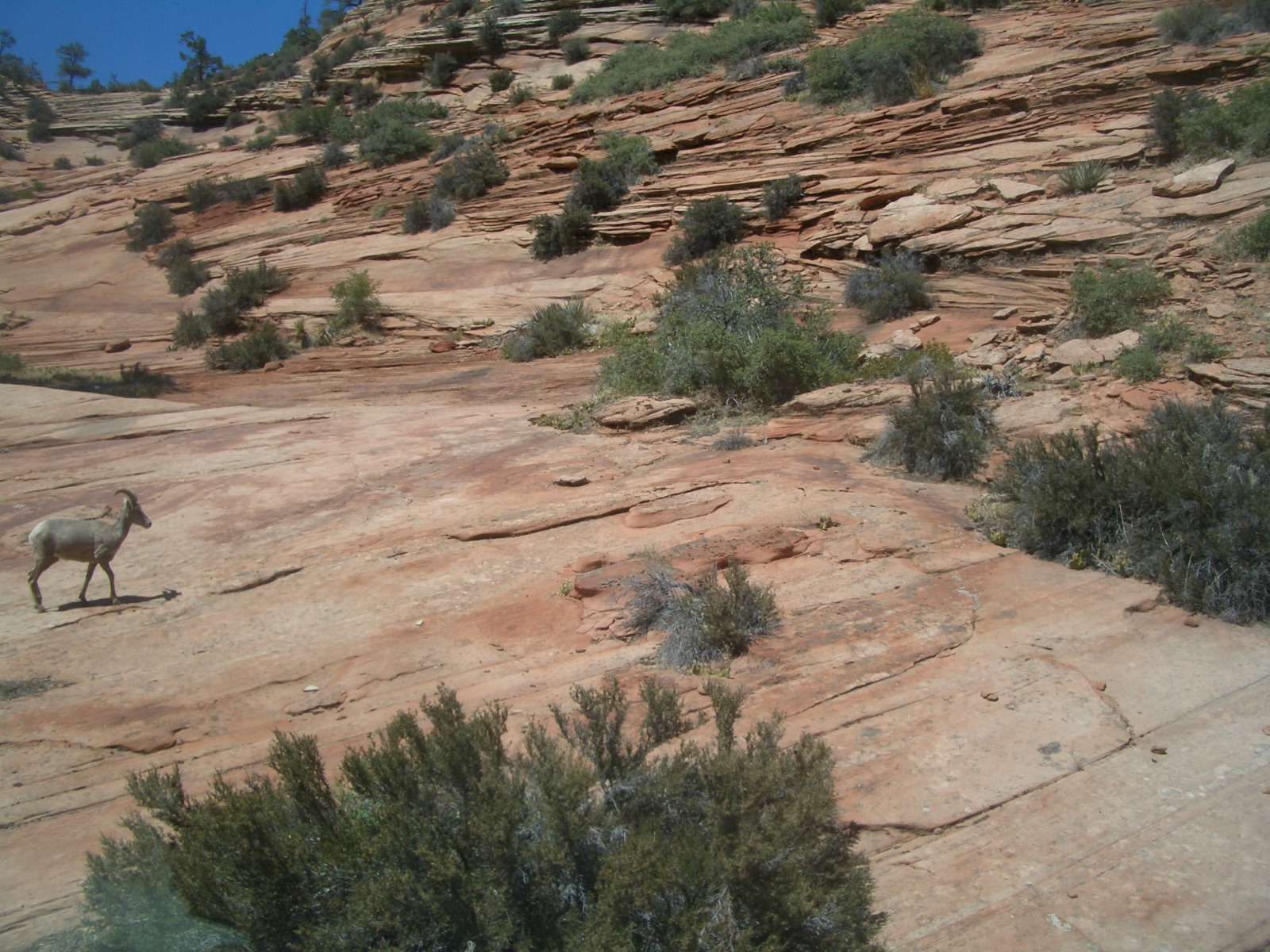 |
| Mountain Goat in Zion National Park |
We took the free shuttle service to see most of the canyon. It was quite convenient and environmentally friendly.
It took us by surprise to see a couple of mountain goats on our drive to the scenic Zion-Mount Carmel Highway. We took this picture from the window of our CR-V.
 | |
| Bryce Canyon National Park June 2012 |
Our second stop was Bryce Canyon National Park
The picture on the left cannot reveal the grandeur of the
canyon below. It is not just because of my simple and humble digital
camera. There is no true substitute for seeing it for yourself. I
still took pictures, although there are many better pictures out there.
The reason is the same for me and other people. I took them because we were in
the pictures :-) They are really just for memories.
There is also a free shuttle bus service in this national park for some key vista points. I really like this service.
 | |
| Switchbacks in the Navajo Loop Trail |
We did a couple of short hikes in the park the next day including the "hoodoo hike" along the Navajo Loop Trail. You got a close look at the hoodoo's. It is well worth the workout. This shot on the left shows the quick switchbacks on our way down to the canyon. Note that we had three people in the picture at various points of the trail. Michael was a distant dot at the top.
 | |
| Deer Having Evening Meal in Bryce Canyon National Park |
Deer families are common scenes in the Bryce Canyon National Park. They are so comfortable with
the environment and they are not afraid of humans at all.
We went to a "star party" one evening for a
nice ranger talk and Power Point presentation on where we are in the
universe. It was quite informative. We are such a tiny speck of
dust, but we are so conscious of our existence. The human race is really
a lonely tribe in the vast galaxies. After the talk, we got a chance to
line up to see the stars and planets through the many telescopes set up by
hobbyists. The most stunning one for my family was Saturn. That
unmistakable ring was easy to identify. It is so much like a textbook picture.
For that matter, we could be fooled if they just put microfilm there on the
eyepiece.
At the star party, I learned to identify the little dipper
(Ursa Minor) by first locating Polaris, and the celestial swan (Cygnus) by
locating the amber blue-green head Albireo and the bright tail Deneb, one of
the Summer Triangle. In the past, I could only identify the big dipper (Ursa Major), Polaris, and Orion. I hope that I can reliably identify the swan
and the little dipper in the future.
 |
| Bryce Canyon National Park Lunch in the Picnic Area |
 | |
| Bison Herd at the Entrance of Grand Canyon National Park |
Finally, we came to the Grand Canyon National Park North Rim. Technically this is in Arizona, not in Utah. We had been in Grand Canyon a couple of times before, but only to the South Rim. The South Rim has better access and is more popular.
The drive to the North Rim was quite serene and beautiful. I really appreciate the roads and infrastructure that get built and maintained. There are a couple of bison herds near the park entrance area. That was our first surprise.
 | ||
| Log Cabin in National Grand Canyon Park |
This is the log cabin we stayed at the Grand Canyon National Park North Rim. We had no wireless access and no TV. That's perfectly fine with me.
 | |
| Jeanet, Joseph and Michael's Mule Ride in Grand Canyon North Rim |

The temperature went up to 110 Fahrenheit at one point near
the California border on our way back. We were glad to be in the car with
air conditioning. We were thankful that the trip was fun, safe, and
uneventful.
Tuesday, June 12, 2012
English with an American Corporate Accent - 027
This is another collection from recent meetings and trips. It works best if you can find a native English speaker with exposure to corporate America to elaborate on the finer points that I cannot cover well here.
* Nothing about the device is a given. We basically have to blackbox the device. [Nothing about the device is a given. We basically have to treat the device as a black box.]
* The data is mind-boggling. [The data is difficult to analyze.]
* You'll never know where is the next kink of the hose. [You'll never know where is the next issue what would pop up.]
* There are many issues to use that, choose your poison. [There are many issues to use that, make your choice and be ready for a surprise.]
* Flash drive is not a stateless device. It depends on what have run before. [Flash drive device remembers things. It depends on what have run before.]
* They have no clues. I have to give the state of the union. [They have no clues. I have to give an overview.]
* They are all resolved under the hood. [They are all resolved without our knowledge.]
* That is a staged approach. [That is an approach with several stages in the process.]
* You don't want to be penned in a corner. [They don't want to be stuck in a corner.]
* We have a litany of commands invented to help with this new design. [We have a collection of commands invented to help with this new design.]
* You can get a lot of mileage out of this. [You can get a lot of good use out of this.]
* It is the vagary of the firmware that puzzles us all. [It is that unpredictable behavior of the firmware that puzzles us all.]
* Let's do that now in case the problem goes awry. [Let's do that now in case the problem goes wrong.]
Thursday, May 24, 2012
English with an American Corporate Accent - 026
This is another collection from recent meetings and trips. It works best if you can find a native English speaker with exposure to corporate America to elaborate on the finer points that I cannot cover well here.
* Some of these items in the diagram are scaffoldings for testing. [Some of these items in the diagram are temporary structures for testing.]
* We need something better, log file scrapping just doesn't cut it. [We need something better, searching for that kind of data in the log file just doesn't meet the need.]
* Do you have the necessary equipment? I might be able to scrounge up a card for you. [Do you have the necessary equipment? I might be able to beg and borrow a card for you.]
* If we do that, we throw out the baby with the bath water. [If we do that, we are overreacting by getting rid of everything.]
* Lack of visibility into that area prevents us from doing more diagnosis of the problem. [The lack of means to know what happened in that area prevents us from doing more diagnosis of the problem.]
* Something went wrong. They bricked the disk drive. [Something went wrong. They completely killed the disk drive.]
* I am spacing out on that name right now. [I just cannot recall that name right now.]
* I am all for chunking things up. We don't need to do it all this time. [I am all for breaking things up. We don't need to do everything at this time.]
* Rob took that a lot further. But I did not plug in to that effort. [Rob took that a lot further. But I did not follow up to that effort.]
* The party line is that now we'll use Brand X drives. [The official line is that now we'll use Brand X drives.]
* I think that will be a ways away. Let's not worry about it. [I think that will be a long time later. Let's not worry about it.]
* You should do a complete job first, then you can pick them out in pieces. [You should do a complete job first, then you can examine them carefully in pieces.]
* If you need to camp on it for a month, we may have a problem. [If you need to have exclusive access on it for a month, we may have a problem.]
Subscribe to:
Posts (Atom)
