Showing posts with label NGO. Show all posts

Saturday, January 28, 2017

my Angkor Wat trip

I joined a 5-day, 4-night Taiwanese tour group to Angkor Wat, Cambodia [1] in mid January 2017, which cost me about $1000 USD with everything included. This tour uses a chartered airline (Far East Airline), and it has no mandatory shopping. The fees for the Cambodia visa and all meals are included.
Cambodia

The paperwork was so streamlined that our passports were collected and processed as a group. The departure date stamp was on our passport before we actually were in the airport on the last day.  They have all the form and appearance of an international formality, but much of the meaning, like departure stamp, has been lost in the process.  Similarly, gratuities for the tour leader, local tour guide, bus driver, and bell boys all have fixed prices and are handled as a group. These fees are not truly voluntary with this practice. The lodging accommodation was excellent with all four nights at Angkor Palace Spa and Resort [2].

Angkor Wat and Tuk Tuk Car
This tour includes not only the traditional Angkor Wat [3], but also the Angkor Thom (Great or Large City) [4] and the nearby freshwater lake, Tonle Sap [5].  There are more than 1000 temple ruins in Cambodia today, but most of them are in the Siem Reap area. These monumental temples were originally for Hinduism, but later the country embraced Buddhism.  Theravada Buddhism is the official religion of Cambodia today, practiced by more than 95 percent of the population. Mahayana Buddhism is the religion of the majority of Chinese and Vietnamese in Cambodia.

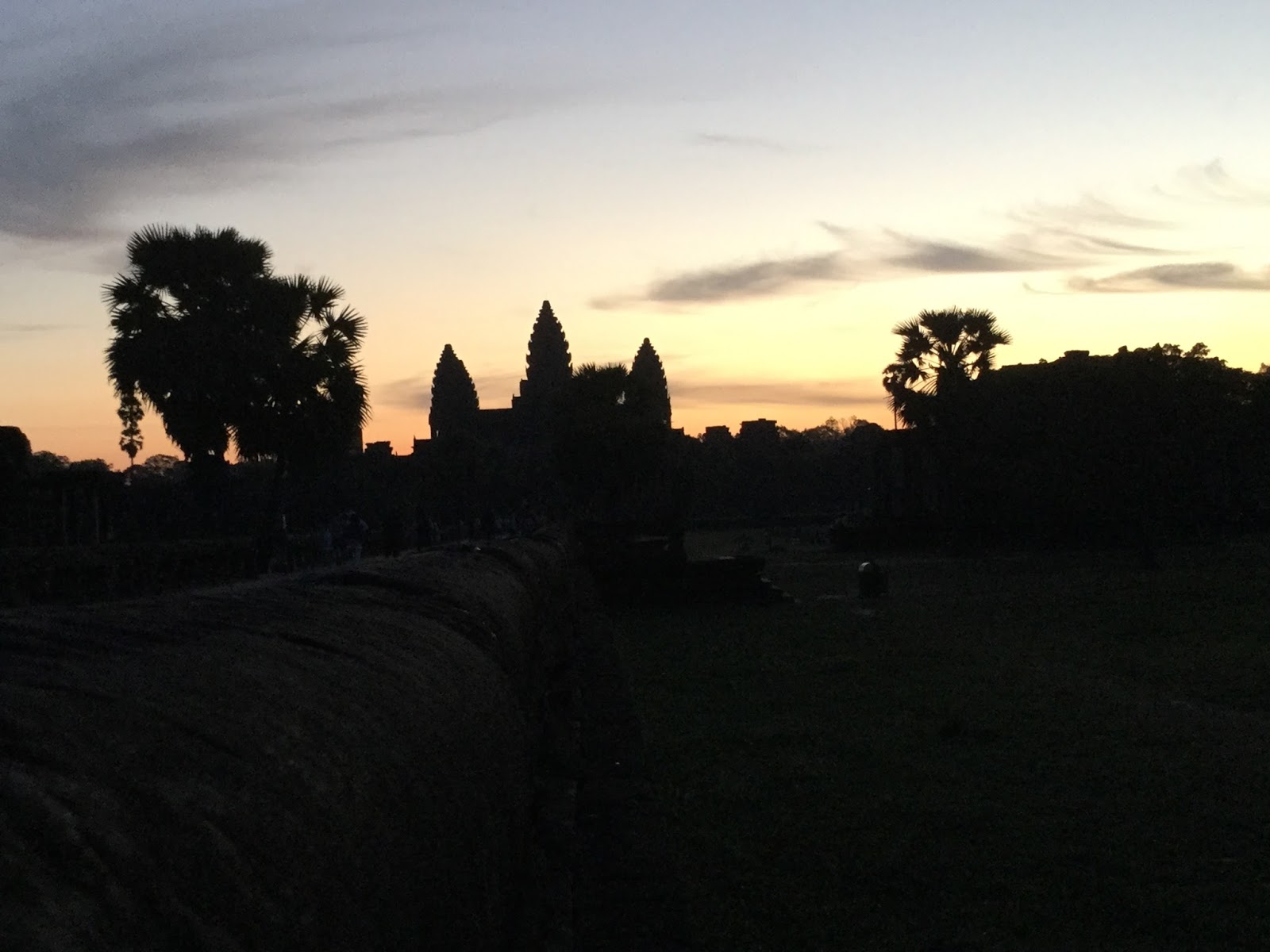
Angkor Wat at Dawn

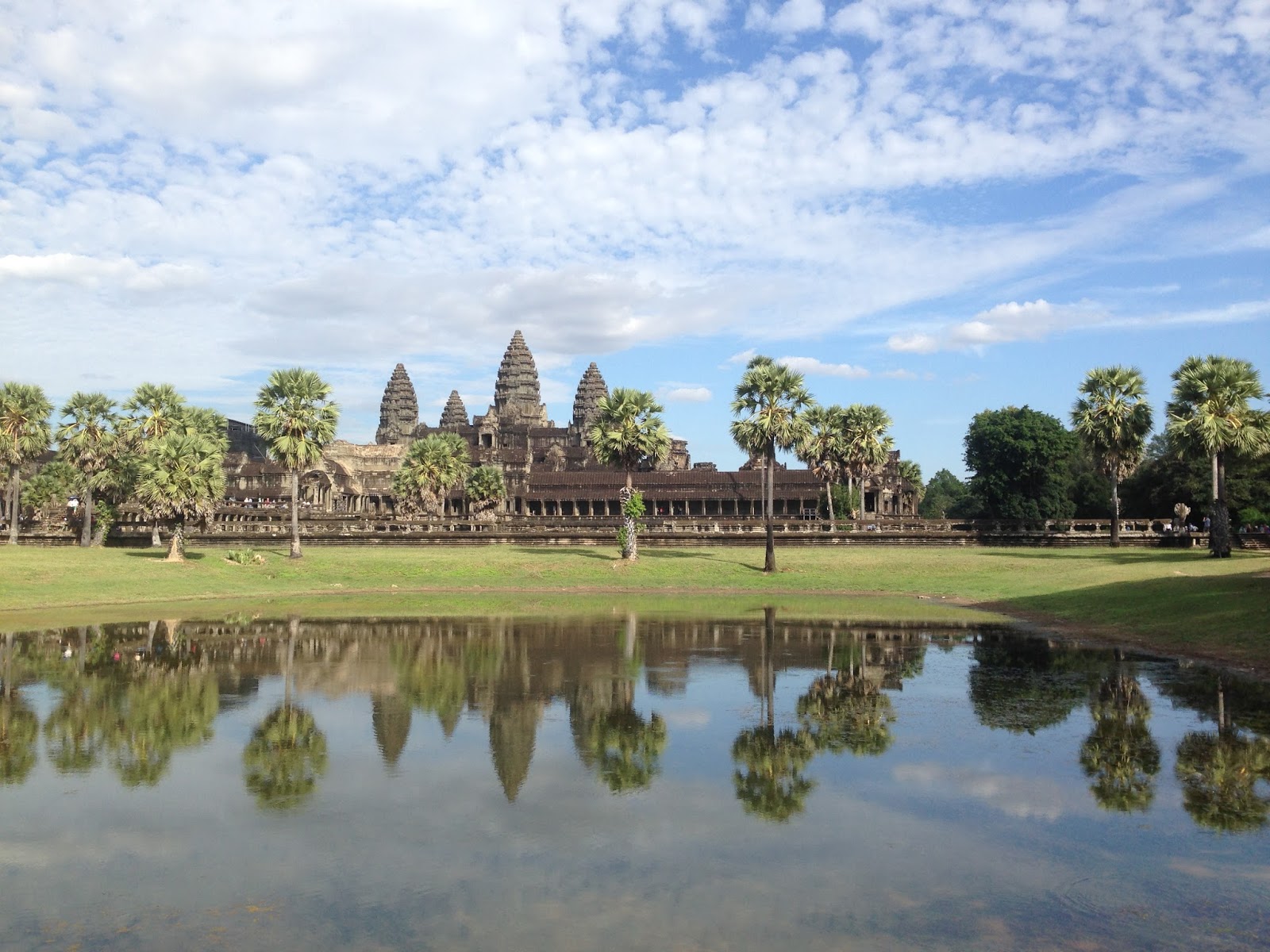
Angkor Wat and its Reflection
Angkor Wat means "City of Temple" in Cambodia language and is in the Siem Reap province.  It was prosperous between 800 and 1400 AD.  Today, it has an international airport, mainly for tourism.  Tourism is the second largest industry after the textile manufacturing. If you google "Angkor Wat" images, you'll find many good pictures.  I have no intention of outdoing those.  Here is a small collection of my images reflecting my particular viewpoints. 


Tree Grown On Top of a Temple Gate


Bas Relief with Hands Flapping to Fly


I am not an art person per se.  But the tour guide was nice enough to explain many special features of the bas reliefs seen in many temples.  I enjoyed very much this animated bas relief with its hands flapping to fly up.


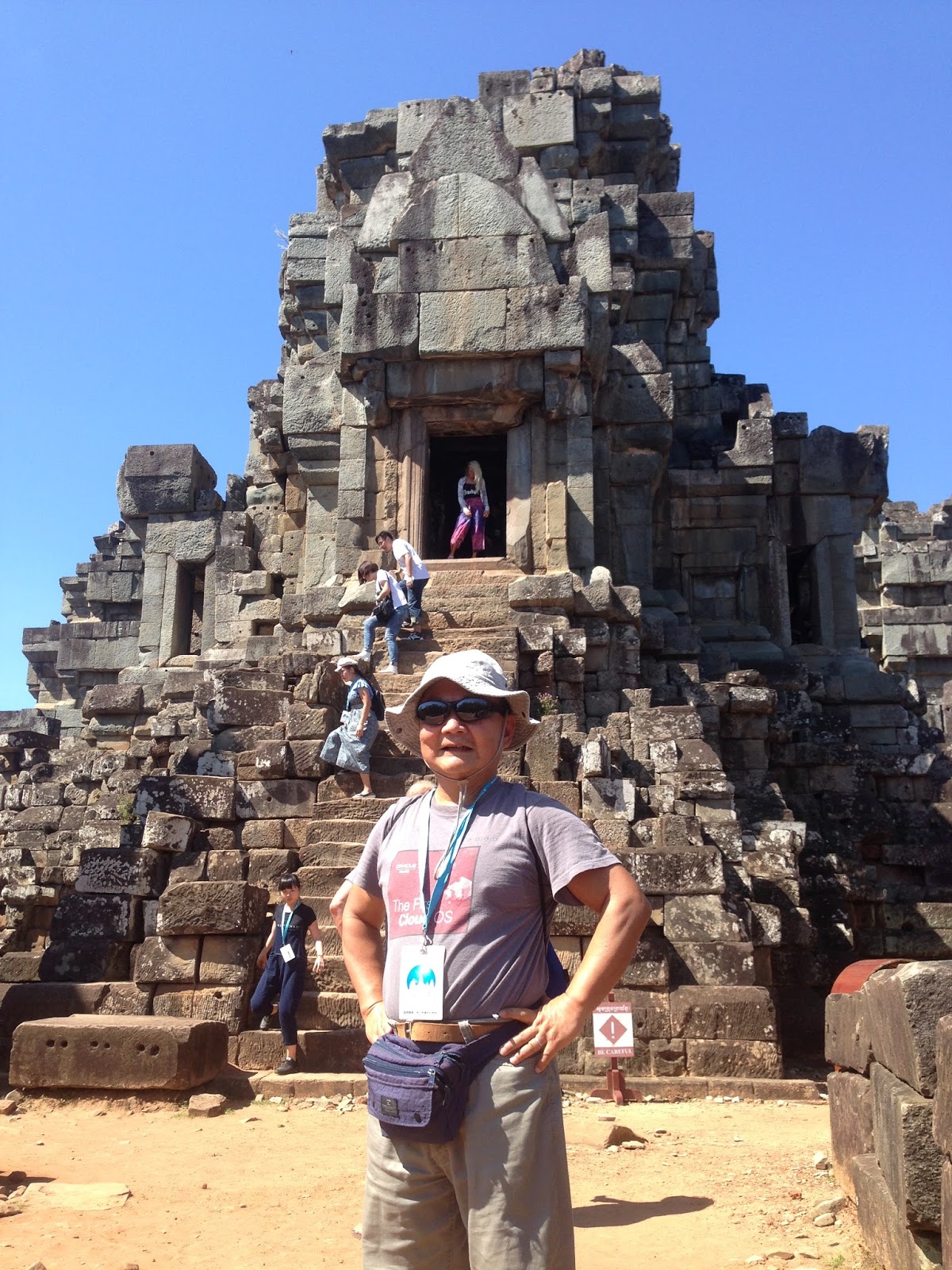
Unfinished Temple with Narrow and High Steps


I enjoyed the strenuous climbs of one unfinished temple. During its construction, the temple was struck by lightening, which was viewed as a bad omen and thus never finished. This temple has no carvings, statues, and other decorations. It has very narrow and high steps and make the climb a little challenging.


Tonle Sap means "Freshwater Lake" in the Cambodian language.  It is a huge lake about 12,000 square kilometers in area during monsoon season. That is 1/3 of the size of the Taiwan island.
Police Station Floating on Tonle Sap
The total area of the lake shrinks to 1/4 of its maximum size in dry seasons.  Many of the houses and structures are thus built on stilts.  Other permanents structures or institutions are on floats like this police station shown here.  You can see schools, churches and shopping venues on floats.


Coconut Drink Treat on a Hot Day
Cambodia has two seasons, that is, the rainy monsoon season from May to October, and the dry season from November to April.  Rainy season can have 22 degrees Centigrade, but the dry April can go up to 40 degrees. Visiting in a rainy season would be quite messy walking about. January and February are usually a great time to visit, with the "mild" temperature of 30 degrees. I enjoyed very much a cold coconut drink after a hard day of walking around the ruins.


Roadside Elephant Ride


The elephants were very much part of the ancient Cambodia history and culture. I only saw a few of them in this trip. This photo shows a roadside opportunity for people to ride on an elephant. The local tour guide explained that much was lost in this war-torn country, and there is not much to be spared or left with when more than 1/4 of the human population was killed. You can watch the award-winning movie "The Killing Fields" that depicted the horrors done by the Khmer Rouge [6].

A simple two-room CTEP school
I took the free/shopping time in town on the last day's afternoon to visit a non-profit project CTEP [7]. CTEP (Cambodia-Taiwan Education Project) is a Taiwanese outreach program in Cambodia with 30 small schools that train young school-aged pupils to be employable in the labor market.
The schools teach computer skills, the English language, and the Chinese language, with the ultimate goal to educate the students enough for the many industries in Cambodia.


The picture shown here is a simple two-classroom structure attached to one of the local elementary schools near Siem Reap.
CTEP class/exam in session
The other photo was taken while a class/final-exam was in session.


The project founder and director is one of my acquaintances in my National Taiwan University days forty years ago.  I find his personal vision and persuasion in doing this work at the grass-root level very convincing and meaningful.  He has a good model going for this war-torn country that regained peace only as recently as 1998.


References:
[1] Cambodia - https://en.wikipedia.org/wiki/Cambodia
[2] Angkor Palace Spa and Resort - http://www.angkorpalaceresort.com/
[3] Angkor Wat - https://en.wikipedia.org/wiki/Angkor_Wat
[4] Angkor Thom - https://en.wikipedia.org/wiki/Angkor_Thom 
[5] Tonle Sap - https://en.wikipedia.org/wiki/Tonl%C3%A9_Sap
[6] The Killing Fields - https://en.wikipedia.org/wiki/The_Killing_Fields_(film)
[7] CTEP - http://camtw.com.tw/


Thursday, May 22, 2008

Bring Your Own Chopsticks! Save Our Forest!

Bring Your Own Chopsticks! Save Our Forest!
2008 Worldwide Volunteer Week
Sun Microsystems Beijing Engineering Research Institute

On May 8, 2008, ten volunteers from Sun China Engineering Research Institute together with two helpers from Greenpeace China held an activity named "Bring Your Own Chopsticks! Save Our Forest!" In China, there are a lot of restaurants that provide disposable chopsticks to customers. We have to cut down many trees to make disposable chopsticks. We need to protect our forest and our environment. We need to persuade restaurants that provide people with disposable chopsticks not to do that. We need to encourage people to refuse to use the disposable chopsticks. Bring Your Own Chopsticks! Save Our Forest!


In this event, our venue was the biggest cafeteria in the office building complex where Sun employees work. It is relevant to our campaign. During the 3-hour event, about 2000 people came to lunch and had to walk by our booth and bench. They could see the Sun logo and banner on the wall and Greenpeace banner surrounding the bench.


We successfully attracted more than 600 people to stop by and listen to what we had to say. We got 350 stickers/signatures promising not to use the disposable chopsticks in the future.


A Finnish TV station heard about and came to this event. Our Sun employee Paul Lee took part of their interview explaining the activity and also explaining Sun's worldwide volunteer week. All volunteers worked enthusiastically with the crowd to bring the environmental awareness into focus, and to encourage them to take actions to protect our forest.


We feel proud to be involved and proud to be Sun employees leading this effort in China.

[N.B.]
I wrote this report together with my good friend Jian Li who took the initiative to start this project a month ago. It is an opportunity to join him and to promulgate this idea and initiative. I treasure this association with him very much since it is precious for me to see this effort in the fast-moving Chinese society. With his permission, I included this in my blog.

Tuesday, April 15, 2008

Non-profit Organizations to Unleash People Power

I talked about my flying hobby and wanted to come back to look at the non-profit organizations in the context of Chinese modernization.

The best equivalent of the non-profit in China is the non-government organization (NGO). In China, the government seems to be the criterion to delineate everything. And in the US, the 'profit' seems to be the criterion ;-).

In China, it is quite cumbersome to start an NGO entity. It is like starting a new enterprise needing big money and structure. Government leaders and the elites cannot quite trust that people can manage themselves and innovate in the collective sense. In a way, this is true. It is a difficult thing to trust people if they are never educated and trained to conduct themselves independently. To work with others and to be governed by rules and laws takes practice and takes time.

As parents, we cannot prohibit babies from walking for fear that they'll fall. We have to let them try and fall and hurt themselves at times. This is the only way they'll learn to stand up and walk by themselves. A parent watches on the side to help them and comfort them, and sometimes teach and discipline them as the circumstances may call for. It is in faith that we believe that we shall not be in a vicious cycle and that our children can never succeed to stand up on their own.

I read one quote from an interview with someone who went through the Cultural Revolution in the 70's. The man said that the net effect of the Cultural Revolution is that no one can longer trust anybody anymore. It was food for thought. If that's true, this was a deeply wounded people and nation. Fortunately, younger generations grow up and have a chance to shake off that burden and gain confidence and trust again in personal relationships. They will be able to build up a new community. The collective power can then be unleashed to serve the common good of mankind.

The line between personal freedom and complete chaos in the society is self-rule, respect, and awareness of the common good. The law and regulations are there to guarantee order and fairness. The lawmakers and the enforcers of the laws cannot be the same entity for obvious reasons; when necessary, the interpreters of the laws interpret and they have to be completely independent of the aforementioned entities.

Similar to many titles in the computer trade books, one day I would really like to see the book and the action entitled "People Power Unleashed" in China.