Showing posts with label Chinese Society. Show all posts

Thursday, July 24, 2014

Taking Ferry from Xiamen, China to Kinmen, Taiwan

Xiamen Airport, July 1, 2014
You could not get from mainland China to Taiwan directly until 2008.  Going through Hong Kong as a stepping stone was a common practice.  The relationship between mainland China and Taiwan has improved so much in recent years that travel between Xiamen and Kinmen becomes possible.  The immigration formalities and procedures are streamlined enough that even foreign passport holders can travel between China and Taiwan through this interesting and often cheaper route.


Nowadays a ferry ride would take only 30 minutes from Xiamen to Kinmen.  There are regular domestic commercial air flights between Kinmen and major cities in Taiwan.  Domestic flights are considerably less expensive than cross-strait flights between Taiwan and mainland China.

Wutong Terminal from the ferry, July 3, 2014
After my business travel to Beijing this time, I flew from Beijing to Xiamen and took the ferry from the Wutong terminal to Kinmen.  The travel agent booked the ticket for me for 190 RMB (10 RMB service charge by the agent).  This is about 30 US dollars. There is a short taxi ride from the Xiamen airport to the Wutong terminal.  The ferry runs roughly hourly during the day.  The web link above is unfortunately only in Chinese.


Tulou Cluster, July 3, 2014


I took a side trip for two days to visit Tulou, west of Xiamen, which is about 3-hour driving distance.  You can see my future Tulou blog for that stint.


Wutong Ferry Terminal, July 3, 2014


The Wutong ferry terminal is fairly new and the immigration procedure is very streamlined and fast.  These days, new facilities like this all look alike with shiny floors, comfortable chairs and good lighting.


Ferry from Xiamen to Kinmen, July 3, 2014


On the day I traveled (July 3, 2014), the ferry was pretty empty, as you can see from the picture to the left.


Kinmen's Ferry Terminal, July 3, 2014


On the Kinmen side, the ferry terminal is also spiffy and fairly new.  The immigration formalities were quick and straightforward.  I have never been in Kinmen before, and this historical island is a place I always wanted to visit in person.


Kinmen Island map at the ferry terminal July 3, 2014
Kinmen and Matsu islands were the strongholds for Taiwan, which are only miles away from mainland China, during the intense confrontations between the Communist Chinese government and the KMT-led Taiwanese government.


One of the M5A1 Tanks that saved Kinmen in 1949

It is interesting to visit the Guningtou war museum that depicted the invasion that the Communist Chinese almost won in 1949 after the People's Republic of China was founded. The man-made underground tunnels that were built to move supplies through heavy bombardment also provide excellent perspectives on that period of time.


Area wise, Kinmen is only slightly smaller than urban Xiamen, which was also an island before the connecting bridges and tunnels were built in the last few decades.  Population wise, there is a huge difference.  Kinmen has about 100 thousand residents normally, while urban Xiamen is home for 2 million people.

Kinmen Airport, July 5, 2014
Shuttle to board plane from Kinmen to Tainan, July 5, 2014

My flight from Kinmen to Tainan took only 50 minutes at 20,000 feet.  Tainan was the historical capital of Taiwan before the Qing dynasty decided to modernize Taiwan.  My younger sister's family is in Tainan, which is an excellent excuse to visit.

The high speed rail (HSR) ride is less than 2 hours from Tainan to Taipei and covers about 250 kilometers.  Since early 2014, United Airlines has offered non-stop flights between Taipei and San Francisco.

Wednesday, April 6, 2011

Yu, Yu Hu, Hu Yu, or Hu - Chinese Names 101

What's in a Chinese name? Chinese people have a last name or family name, and a first name. Most of the last names are a single Chinese character that corresponds to an ideogram. The first name are either one or two Chinese characters. It is commonplace to see one-character first name in modern-day China. Each ideogram is phonetically a short syllable, and the four-tone intonation is not encoded in the Chinese Pin-Yin system. You find many similar names that need to be disambiguated.

Let's use an example. An engineer friend is generally referred to as HY. HY's last name is Hu and his first name is Yu. Chinese refer to people as "Last name, First name," and thus refer to my friend as "Hu Yu". This is natural for the those who speak Chinese. Note that this direct reference is not particularly polite in general. It is used only when certain clarity is needed. The same is true in the U.S. cultural.

Since Western conventions and cultures use the "First Name.Last Name" format in email address and other places, it is common to see "yu.hu@company.com" as an email address. It is the U.S. culture to refer to people by their first name when we are reasonably acquainted with them, and therefore we are expected to use "Yu" to refer to this friend . If you insist on calling him "Yu Hu," that would be odd but excusable if you are not a Chinese native ;-) Another colleague once asked me why "Hu Yu" was used by another Chinese engineer, and that confused the hell out of her. Which is which?

In conclusion,
1) Yu - First name, American way, when you are reasonably acquainted
2) Yu Hu - First name followed by last name, American way, not too polite, used only for clarity.
3) Hu - Last name, used occasionally in special circumstance to refer to someone remote.
4) Hu Yu - Last name followed by first name, Chinese way, can be used by superiors.

Remember the problem of the short syllable and one-character first names for this generation? It is likely to have someone with Yu as last name, Hu as first name. Now, you would really have to ask for clarification.

Tuesday, August 10, 2010

July 2010 Taipei Stint

I stopped over in Taipei, Taiwan, on my way back to San Francisco in a recent business trip to Beijing.
I grew up in this metropolitan city until I graduated from college. Then I went "abroad" to study, which led eventually to my emigration to the United States. I remember that when the economy started to take off in Taiwan forty years ago, the traffic was a mess and people were crowding up everywhere with no waiting lines or signs of civility anywhere.

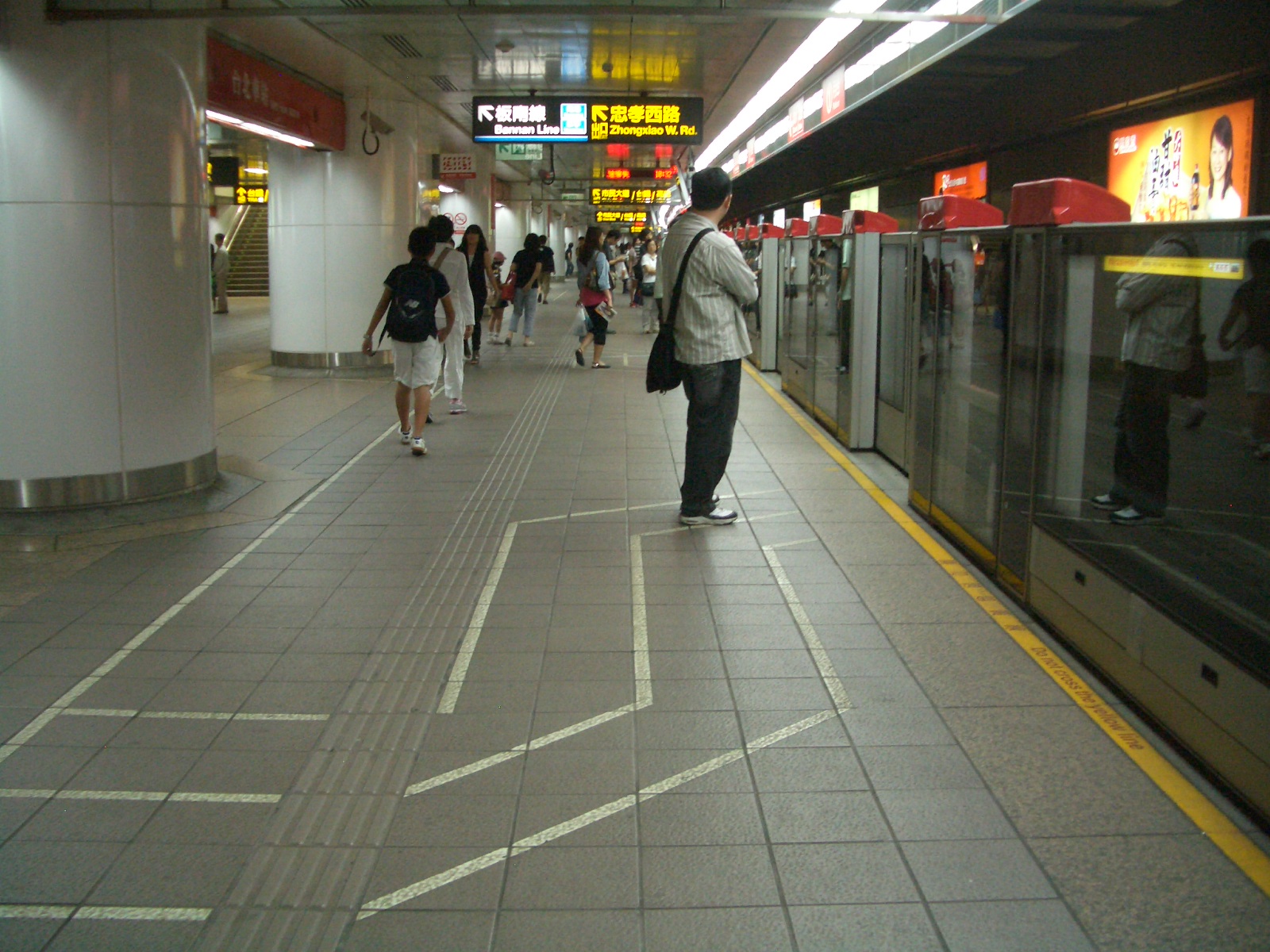
Things are different now. I was impressed by the Taipei subways a few years back when I attended the IDF conference. This time I took a few snapshots during this short visit.

To the left are photos of waiting lines for Taipei subways. Waiting lines are marked to avoid the out-going passengers. These two were the "before and after" pictures with people waiting for subway train to arrive.


Now, what ushered in the civility and good manners? Is chaos a necessary step on its way to civility? What are the necessary conditions to lead to this path? There are many places in the world today that have not gotten out of their chaos in recent memory. Why are they stuck?

Subway station signs now are in the PinYin romanization system instead of in the traditional Wade-Giles system used in the island. My name "Tzongyu Lee" would have been "Zongyu Li" in the new schema of things. But just as "Taipei" and "Tsinghua University" do not get converted to "Taibei" and "Qinghua University", my name is not going to change. The Pin-Yin system is only 50 years old, while the Wade-Giles has 150 years of history. Established names are not going to change for the sake of change and uniformity. Subway train announcements were in Mandarin Chinese, Taiwanese, English and sometimes even Hakka Chinese is heard.

Taipei scooters are popular. They offer something motorized and fast, and they are easy to park and can squeeze through the traffic.

There are many foreigners and laborers from abroad including overseas Chinese returning from North America. Foreigners are so common and often go unnoticed. Some of my friends told me that they enjoy this atmosphere of anonymity, and do not have to worry about being cheated one way or the other.


I took the opportunity to visit Danshui (Tamsui) via subway after I took care of some personal business.
Danshui is situated at the mouth of the Danshui River on the northwestern side of Taipei. I bought the ferry ticket pack to Bali (across the river) first, to Fisherman's Wharf next, and back to the old town for 120 Taiwan Dollars ($4 USD).


To the left is the Bali ferry terminal with Mount Goddess of GuanYin (Goddess of Mercy) in the background. I rented a bike for a short round-trip 6 miles ride to visit the ShiSanHang (Thirteen-Shops) Archeological Museum.
The distance is not far, but the scorching heat with stifling humidity was hard to bear.


The museum is right next to a waste water treatment plant. The plant is actually housed in 6 giant jars. I thought they were the ThirteenShop Archeological Musuem at first because of their artistic design ;-)


The museum was designed with Italy's leaning tower of Pisa in mind, from the look of its main building. It has some interesting artifacts and history. The material dated way back, much earlier than 1600's Dutch Formosa, which was quite interesting to me.


My last stop was the Danshui Fisherman's Wharf, which offered a nice boardwalk and a relaxing atmosphere. It was quite commercialized, though.


I learned to stay indoors next day because of the heat. I ended up finding a nice exhibition on the "Legends of Heroes - the Heritage of the Three Kingdoms Era" in Taipei's National Museum of History. This turned out to be a surprisingly nice visit. It had a good collection of paintings, crafts, artifacts, stone rubbings, and so on from many different museums in China.
I happen to be listening to the story-telling version of the MP3 "The Romance of Three Kingdoms" on and off during my travels in the last year or so. It was really a treat to me to see this exhibit in one place, with some level of analysis between history and legends.

Tuesday, August 3, 2010

Colonel Sanders is very popular in China

I had a 2-week business trip in the second half of July and could not help but write about this KFC phenomenon.

KFC is a yuppie place in China. It carries status and often is a favorite place for young people to meet. You can search on "KFC in China" and find many interesting write-ups and observations of this incredibly vibrant fast-food chain, which is uninteresting in the United States.
A book with this as the title can be found at Amazon.com.

To the left is a snapshot of the ordering line in Beijing's WangFuJing shopping district in late July 2010. The hustle and bustle is an envious for any business.


Colonel Sanders and his sepia pictures of the young and old times are familiar scenes in many of the KFC restaurants in China. I can only remember seeing one such display in the United States.


KFC is innovative in its product lines for the China operations. In addition to the traditional Kentucky fried chicken, nuggets, and fish burger, it offers traditional Chinese breakfast like rice porridge and fried double-twisted dough. There are other new ideas and inventions in drinks and burger/bread packaging, and ingredients. Small, popcorn-shaped fried chicken nuggets packaged in a popcorn container is one of the new inventions I like.


KFC does a great marketing job, including this Beijing subway line 2 advertisement in the connecting pathways.

Saturday, June 19, 2010

Technology, Reverence, and Justice

Technology, Reverence, and Justice. What do they have in common? The combination had no meaning for me until recently.

I don't watch TV very often. Instead, I enjoy outdoor activities such as hiking and swimming. Most of the TV news and programs are too superficial for me. Casual entertainment from TV programs is OK. But, gluing oneself to the TV and believing whatever it conveys is detrimental to our intellect and to our judgment. We need to be able to read more and to think more. I find it depressing that TV, and media in general, is shaping our value systems and moral guidelines. We are easily misguided by the media. And the noise of media have drowned our senses and reduced our abilities to act properly. We can easily lose our peace and senses in this fast-paced world of constant media bombardments.

I do find some exceptions. I don't find that the latest breaking news is important. I can only watch CNN for 20 minutes, and after that, it becomes repetitive. For an in-depth look and no-hype news, I find that PBS's NewsHour is acceptable.

Since my return to the US in early April, I did watch some TV - mostly PBS programs, in Davis, California when I visited my mother. By the way, she is doing so well now that she "graduated" from the hospice program last week. We are all quite pleased with this news.

One evening, I happened to tune in to Bill Moyers Journal, a PBS program dedicated to public affairs. This used to be my all-time favorite program before I left for China. That program ended Friday, April 30, 2010, and I happened to be there to hear the news. Mr. Moyers is 75 now and it is unfair to ask him to continue on.

That was the evening I learned how technology, reverence and justice are related :-). It is so relevant to modern-day China, and I have to share this with my friends. For the last 100+ years, the Chinese government, and many individual Chinese, have believed that the serious lag in science and technology is the reason that China was repeatedly defeated by the imperial and colonial powers, and that is the reason that China has to play catch-up to be a world leader again.

I have always tried to find what other elements are essential to a successful and sustainable civilization. Technology is essential, but that is definitely an incomplete answer to me. In this episode of Bill Moyers Journal, the following excerpt from Barry Lopez filled in the missing pieces in my puzzle.

(quoting Barry Lopez)
I don't remember the philosopher, the Greek philosopher who told the story of Zeus and Prometheus. Which really stuck when I first heard it, is that Zeus said to Prometheus, "Okay, you stole fire. Great for you. Now your people have technology. Wonderful. But here's something you don't know. You lack two things. And if you don't take these two things that I will give you, this will be a failure. Technology, you know, fire, all your magic, it will fail completely. It will be your undoing. And the two things that you need to make it work are justice and reverence. And if you have these two things, you won't get in trouble with this third thing that you thought was the be all and the end all."
(end of quote)

Is this that simple? Reverence and justice are the missing pieces? History and Greek mythology can have such foresight? Justice is a serious problem in China and many other parts of the world. Inequity is prevalent and might eventually bring serious changes to the social and political systems. Reverence is profound respect, and it is definitely a virtue for individual and society as a whole. I remember that there are good examples of reverence teachings in the Chinese history. Right now, Chinese society has been pressured into modernization with materialistic goals. It is a society with impatience, disrespect, and hatred at times.

It is not easy to get to a harmonious and reverent society. We have to bring back justice and a deep sense of reverence to each other so that technology will be good for us.

Thursday, February 11, 2010

The Pursuit of Happiness - Owning a Home in Beijing


[Home, Sweet Home]

Although China is still a socialist country in name, people already found ways to express their personal desires and aspirations. Having a home is a dream for many Chinese. And having a home tailored to their tastes is reflected in a big way by the plethora of choices in furniture, home decorations and essentials. Owning a home is a very basic element of happiness. This pursuit of happiness is happening in China everywhere. I cannot help but to compare this basic inalienable right of the pursuit of happiness to the U.S. Declaration of Independence.

[A Typical Home - an Apartment]

A typical home is an apartment unit in the city. A suburban house in the U.S., with a nice backyard and two-car garage, is not practical for the typical Chinese. That type of home is referred to as a "villa" or "resort".
Housing prices are one of the hottest and the most discussed topics in people's lives. The dream of owning a house certainly adds to the demand side in the emerging Chinese economy. But
the opportunities of making quick and large short-term profits in the housing market attract many speculative investments. Government interventions are frequent, but it is hard to to be sure that the new regulations and polices achieved what they were intended to. It is sad to watch the middle-class in anger and in despair.

[
What do you get as a new Home Owner - the Phase I Home Project]
One thing really unique in China is a so-called "bare-bones apartment" delivered to the purchaser of the new home. Let us say that the Phase I home project is completed by the developer and the new owner must hire contractors to do the Phase II work.
To enumerate a few of the must-do items: the ceiling has to be leveled, conduits have to be planted into the walls for desired plumbing and electrical wiring, and then walls need to be painted. The frame of the apartment is concrete. The 2x6 frames and plaster board/sheetrock that are common in many American homes don't exist yet. After that work is completed, work can continue: laying floors with ceramic tiles or wood panels, and installing doors, moldings, switches, electric plugs and light fixtures. The kitchen and bathroomare bare. All cabinets and basic elements of a bathroom have to be added, including a water heater and natural gas plumbings.

The picture to the left is a typical new "kitchen". It is bare-bones and looks quite devastated. It has radiator heating elements, a sewer line and some water pipes.


This picture to the left is what you get for a bathroom: a radiator, two electricity outlets, a water pipe, and a sewer line receptacle for the toilet on the floor.

It is very difficult for a new home owner to start from that point. But the Chinese take this as the norm these days. You might wonder about how much time and energy is spent and wasted along the way, because every new home owner must go through the second phase of home building to create a reasonable place to live. Only then can the homeowner begin to decorate.


The third photo of this primeval series to the left is a picture of the guest bedroom leading to a small balcony for drying clothes. It is easy to see that you need to wire for electricity, and to provide a door, molding, and flooring.

I call this a Phase II home project to distinguish it from Phase III. Phase III is the actual furnishing of the apartment, such as adding a dresser, bed, dining table, sofa, TV stand, refrigerator, stove, sink, washer, and other essentials. This Phase II work is unique in China. Most people have to spend 3+ months haggling with contractors to get things done correctly. And many spend a year or more to really complete the Phase III furnishing projects. Many are short of funds and are completely exhausted after Phase II work is completed.

I observed the following list of priorities in Beijing (from high priority to low priority): living room declarations, sofa, TV, guard rails (for windows), refrigerator, kitchen stove, sink, master bedroom essentials, dining table set, washer, bathroom toilet and shower stall.

[After the Hard Work of Phase II Home Project]

To compare the “before and after” of basic room finishing project, see the photo at the left. Here is a kitchen after flooring, ceiling, countertops and shelving are installed. Remember that the new home owner does this by selecting the materials and then subcontracting the work out. Notice that a range/stove and a sink are also in place in this photo. An 11-liter natural gas water heater is on the left wall with the gas meter at the end of the narrow kitchen. The long, narrow kitchen is typical in city apartment/house units. An open-space kitchen design is considered outrageous and unthinkable for the Chinese. Chinese cooking involves a lot of stir-frying and quick flame and smoke, so the Chinese usually like to keep the kitchen separated from the main open space of the apartment and house as a practical matter.


As a comparison, a remodeled bathroom is shown here to the left. It is quite a nice sight with the ceramic siding and a flushing toilet. The heater is slightly relocated to the front and closer to the door, and thus not quite visible. The glass shower stall and the sink are close to the door and to the right, and therefore are also not visible in this picture.


The guest bedroom is shown with built-in bookshelf and a computer table on the left and a closet on the right. A door opens to a small balcony that is curtained and normally used for hang-drying clothes.

[Furniture Shopping]

IKEA is big in China. It must have been an eye-opening experience for the Chinese when it first opened. Today it still attracts people who just come to look. I think that following are some of the reasons:
1) Comprehensiveness in terms of home furnishing needs. It is one-stop shopping.
2) No price haggling, so there is no negotiation required.
3) The modern and utilitarian designs are from the Scandinavia. These designs especially attract the new middle-class young couples.
4) There are places in the store to sit and rest, and even to eat.

To the left is a photo I took in one of the weekends when the place was packed.


IKEA is a new concept, but there are many other ways to meet home furnishing needs. There are furniture shopping malls in which a homeowner can find a great deal of name-brand furniture.
LanjinLijia is a furniture mall frequented by the middle-class in the northwest corner of Beijing. The variety and selection are good, so that this store could be a one-stop shopping place for people who wish to complete the modeling/remodeling and furnishing of their new apartments in one trip. These types of furniture malls are scattered throughout the city. It is difficult to see how smaller outlets can survive in this competitive environment.


To the left, you can see a nice 90 cm by 90 cm shower stall for 1200
RMB in the furniture mall. But many Chinese apartment owners place bathroom amenities at a low priority. Very often you can expect to see only a simple shower head over the toilet. People in China probably cannot imagine that American bathrooms receive much more attention. The room is even often carpeted outside of the shower stall and/or bathtub area. The same mentality prevails over the treatment of restaurant restrooms in terms of their importance and appearance. It is all too common to find lousy restrooms in nice Chinese restaurants inside and outside of China.


[Furniture City]

There is a giant Furniture Super Mall southeast of Beijing, the XiangHe Furniture City.
The picture to the left shows one of the many gates to the warehouses of furniture stores. As is typical in Chinese government planning and organizations, similar types of furniture are grouped in nearby parcels. That is convenient to the shoppers, but difficult for the merchants in differentiating product offerings and prices.


Free bus transportation to this super mall on weekends and major Holidays is available in 20+ locations of the Beijing city. I once took the bus from the east gate of the University of Geology in northwest Beijing. It took about 90 minutes to travel the distance of close to 80 km.
The picture to the left shows a converging bus depot for all the buses to come together. Some reshuffling can be accomplished to pack shoppers into different buses for the sake of efficiency.

Wednesday, December 9, 2009

Down with the Chinese Capitalism!

[Really no regular thermometers?]

My wife had the flu and a fever, and I could not find our good old-fashioned thermometer after our recent move. The drugstore told me that fact with a straight face, but the clerk also told me that the much more expensive electronic ones are available. Was the clerk really telling the truth? Or was this yet another example of institutionalized price gouging? For months now, it has been difficult to find affordable face masks for the H1N1 epidemic. Only the so-called "advanced" models are available, but they are expensive.

It is not really possible to legislate business ethics and morality. Those qualities are a matter of one's free will. Moral and ethical behavior is social and cultural, and is based on value systems. Many people can be law-binding citizens but can be very crooked any way you look at them.

[Bargain for a dead body]
I saw this picture in my daily dose of mobile phone news. I was outraged, not simply because the picture depicted bargaining for a price to the dead body the boat crew was able to retrieve, but also because of
the loss of human decency and dignity. I felt deep pain and outrage. What if I were this corpse's parent and what would I do if my son's body were waiting to be traded. Was it worth 12000 RMB?

You can also read the story about 3 college students who perished while saving two children in the Hubei province. You can read the CCTV's version. Society has become so selfish, and thus we have created heroes before our own eyes. What's wrong with this society? Where is the beloved government and leadership?


[China is a haven for Capitalism]
This country is sick. The last 30 years of economical openness and reform without corresponding political openness and reforms has turned the people into money-worshipers and government into investment bankers. Can China be capitalism's last haven? What happened to government and leadership? What are they focusing on? On maintaining the 8 percent year-to-year growth in GDP ?

The government's job seems to paint a glorious picture of an economical boom and military advancement. Have state-run branches invested in the Blackstone mutual fund again? Why is the government making such investments itself? Is it trying to create regulations so that there is a level playing field that benefits everybody, and now is it thinking how to make the pot of gold grow bigger? The government has screwed up its priorities big-time.
Maintaining a strong military power to defend the motherland while the poor and needy are crying out loud for justice and help? We are in the 21st century now. Does the government really see any serious threats from other countries and regions?

[Refocusing on the social fabric and value systems]
The government should refocus its energy and priorities to address the needs of migrants, the aging, minorities, and the medically deprived. Domestic justice and the fabric of society are in serious need of being repaired. A harmonious society is not just a noble goal or slogan. If the moral, ethical and spiritual emphasis is not there, society will continue to become corrupt and eventually collapse. The government will go with it.

On this note, I was by chance introduced by my good friend CH to the film director Jia Zhangke. Anyone who is interested and has the stomach to see the raw aspects of modern-day Chinese society should watch his films. Maybe in time he'll be the Charles Dickens of China, depicting the country as it goes through the painful process of modernization.

Friday, October 9, 2009

Swimming Etiquettes in Beijing

I enjoy swimming very much. This is one of the few sports that won't hurt your joints and muscles. I am not a good swimmer and I swim about 500-700 meters each time for about 30 minutes. I picked up lap swimming in the Scotch Plains YMCA 20 years ago. I have never truly completed my swimming lessons, as I just could not manage the 'breathing' technique. So I had been using a snorkeling tube until a year ago. Years ago during my college days, I yelled help after only two sessions when the coach took us beginners to the deep end to practice. I think that subconscious fear of deep water was the culprit in preventing any further progress.

[My Swimming Epiphany]
A snorkeling tube is a rare sight even in the U.S. I used it to breathe so that I can move all my limbs. I was simply too tense and too nervous. I could not sustain a regular breathing pattern without going into a vicious cycle of sinking in deeper and deeper.
A young child at Huaqing Garden swimming pool once asked me what sort of special technique I was learning with my snorkeling tube. I was embarrassed and told him that I needed it because I had not mastered the breathing technique yet and that he should be quite proud that he didn't use this apparatus.

I learned to breathe finally with encouragement from the lifeguard Mr. Chen. He showed me that a true beginner friend coul
d start to do breast stroke in a few months on a once-a-week schedule. All I needed was to relax and not get in a panic when I did not breathe in enough or got some water into my mouth. Being able to stay calm and recover to normal breathing pattern was key to my epiphany ;-) I was so pleased with this breakthrough, because I never thought it would be possible in my lifetime. Here is a picture of me without the tube in Sanya, Hainan at the end of last year.


I have listed below my observations in and around Beijing swimming pools. Since my samples are limited, I would be cautious in generalizing these observations too much.

[Locker Rooms and Shower Stalls]
When you are done with swimming, drying off right after the shower is common in the U.S. since the locker room area is usually carpeted. Locker rooms are rarely carpeted in China. You are lucky if they do not use ceramic tiles for the floor. The pool I had frequented in the last two years finally
changed to a material similar to artificial turf, and I don't have to be extra careful and apprehensive of slipping and falling.

Some facilities have a sauna installed. In one place, the management finally gave up on repairing the sauna unit. Too often I have witnessed abusive users pouring water directly over the hot rocks. It is dangerous and also likely to destroy the sauna unit. I understand why management just gave up on this endless repairing, and it is a shame not having that sauna to use after a good swim.

Shower stalls have
good water, hot and cold. But normally that drainage system is not designed to match the usage volume. Standing water here and there is quite common. It is often quite slippery in the shower area. Here is a sign I like. Instead of "Slippery, please be careful," it says "Slip Carefully." I am not sure what the Korean translation says.


[Swimming Pool Access]

There is always a wading pool to wash off your feet between the locker rooms and the pool. They could easily install shower heads to cover the access pathway so that people can really clean themselves before entering the pool. Although "shower before swimming" signs are posted in clear view, there are still some people not observing them.

[Swimming Etiquettes]
It is a common practice to put fast swimmers in the middle lanes and slower pokes on the outside lanes. This is usually clearly marked in the U.S. It is natural to let good (and faster) swimmers avoid the slower folks by staying in the middle lanes, since slower ones like to hang on and be close to the side walls of the pool. When sharing a lane, it is common in the U.S. to see a sign reminding swimmers to "split lane with two and circle with three or more." Here, people just swim in all directions, which is similar to Beijing traffic. Parents and instructors do not teach their children common sense like "see and avoid" and "pool courtesy."

It would be a while before you feel a higher level of civility in the swimming pool. There is no incentive to formulate common-sense rules as far as I can tell. Everything is from the top down, possibly all the way from State General Administration of Sports. A centralized system naturally limits its innovations and improvements to the selected few elites. Scaling is a big challenge to China in many of its policies and regulations.

Although there are signs showing "no jumping/diving" in shallow water, many children are ignoring the rules. Safety consciousness is not big on the teaching agenda.

[Pool Usage Convention]
I am not aware of any ideas along the lines of family swim versus lap swim. All pool areas are either all divided into lanes or completely open. Poor lap swimmers usually have to avoid the beginners and those who are simply playing around for fun.

Swimming is still considered fun and entertainment for families and individuals. Pool schedules are tailored to this type of usage. No pools are open to meet the needs of work-out times such as early morning (before work), lunch time and early evening (after work). Most, if not all, pools operate at management's convenience, not at users' convenience. This reminds of my friend SX's one-liner: There are no rights, only obligations for the individuals in China. It is so true.

[Others]
No photos are allowed in most swimming pools. I don't know why.
Men and women all wear caps, a policy that is mandated by pool management.
A deep water certificate allows swimmers to be in deep water areas. To get a certificate, you must pay 10RMB to apply and must be able to swim 200 meters and tread water for 30 seconds.
There are often swimming lessons for children, especially in the summer time. There are many more bystanders (parents/friends) than students. A typical scene in China.


Tuesday, September 30, 2008

Imperfection is Just As Beautiful

Imperfection is just as beautiful if not more beautiful than perfection.

I was more inspired by the 2008 Paralympics in Beijing than the "regular" Olympics. The XXIX Olympics was a great event, but simply a good show in some ways. The Paralympics had some sadness to it. One taxi driver mumbled to me that it was heart-wrenching for him to watch the Paralympics competition. I felt the pity and the "why bother" attitude in his tone. Many of my friends here were inspired by the physically challenged athletes; but, for the most part, Chinese society needs to open its arms wider to accommodate better the marginalized and the disadvantaged.

Relatively speaking, Chinese society and infrastructure is not friendly to the disabled population. A wheelchair-bound individual cannot move about in Beijing, let alone in other cities in the country. I would never haul two suitcases from the airport to my apartment using the subway unless I were desperately poor and could not afford other means of transportation. Escalators are not guaranteed to be there, and you have to walk up and down the stairways. Elevators are there sometimes, and they are often locked and not available. When you have two 20 kg suitcases to deal with, you can be considered physically challenged. The sad fact is that I do see poor people transport their luggage in the subway. Some of them don't have suitcases, just two big tote bags.

To see and hopefully to accept imperfection is good to begin with. Only people with confidence are comfortable with their shortcomings and handicaps. Chinese have yet to get used to this new notion and to love themselves deeper in the face of imperfection. There are good examples, although the media and society don't show them often. Parents in China are as dedicated to their disabled children as parents in other parts of the world. But the media and society shun away from them and rarely shine a positive light on this group of people. Some Chinese even believe the traditional idea that imperfection stems from the wrong-doings of a person's previous incarnations. A sense of guilt and shame is quite common. The Paralympics is good for Chinese audiences; the Games made it easier for the disabled population get out of their isolation and to push the envelope a little.

Chinese are obsessed with perfection and that's not heathly. This burden is unbearable and is not sustainable. Chinese have to learn to accept the reality of imperfection, and have the spirit to overcome, not to overcompensate, for it. Politically, it is also good to accept imperfection; that is the hallmark of democracy. Mediocrity is a fact of life, and we are making a conscious decision to trade this for the long-term stability of the society. An error-free, austere political machine is just a facade. It is inherently unsustainable and there is no breathing room in it.

The Paralympics was a good thing for China. Many of us should be thankful for not feeling challenged in any perceivable way. One day, we will all become disabled as we get older and by then we should be able to realize the need to provide equal opportunities to the disadvantaged. I like the 1997 Academy Award winner for Documentary Short Subject, "Breathing Lessons: The Life and Work of Mark O'Brien" that says "sooner or later, we'll all become handicapped." It is a 35-minute film. Watching it will be good for you spiritually and philosophically. :-).

Wednesday, September 10, 2008

Reflections on the 2008 Beijing Olympics

The Beijing Olympic Games were "truly exceptional Games," said International Olympic Committee (IOC) President Jacques Rogge at the Games' closing ceremony staged in the National Stadium in northern Beijing on Sunday night, August 24, 2008.

This is a fair overall assessment of the Games of the XXIX Olympiad. A few reflections are in order since I was in the city for the last two years and attended three events, men's gymnastic, women's skeet shooting, and men's boxing.

[China's Favorite Sporting Son]

China's favorite sporting son, Liu Xiang, had to pull out of his defense of his 110 meter hurdles title due to an Achilles tendon injury, leaving his legions of fans heartbroken. He is a man who could be more influential than the PRC President in what he says and does. He is now depicted as a cartoon character in one TV show I happened to glance at recently; every child in China will probably recognize him. I hope that a hero like him can do more for China beyond the 110 meter hurdles event.

[Nationally Organized Sport Promulgation]

China has a national-level office, the State General Administration of Sport, to promulgate sporting events and training and to win medals in many venues. This is another good example of Chinese efficiency in execution when action is needed. A news report last week mentioned that 800 million RMB was spent for the 2008 Olympics in athletes training; and with 51 gold medals, each cost about 15 million RMB (about 2.2 million US dollars).

As far as I know, there is no counterpart in the US. Almost all sports organization are grass-roots organizations. Rules and regulations are defined and run by these non-profit organizations. I am familiar with high school level wrestling and swimming, as these are the sports my children participated in. I think that reaching the grass-roots level should be the aim for China to be sustainable in medal counts. A healthy and fit population should be the eventual goal of any government-sanctioned effort.

[Handing Over the Olympic Flag to New Host City London]

London Mayor Boris Johnson received the Olympic flag from Beijing Mayor Guo Jinlong during the closing ceremony on Sunday, because London is hosting the next summer games in 2012. To the Chinese, it might seem odd to see the Beijing Mayor having such an honor. Mr. Guo is not even listed in the CCP page, which lists 30 or so names as members of the Politburo of the CCP Central committee. If you want to count "status or standing" in Chinese politics, that is where you should look first.

The tradition of having a city, rather than a country, bid to host the Olympic Games is something novel to the very centralized Chinese system in the first place. Mr. Guo, as the mayor of the host city, was the one to do the job, and not anyone else, which was refreshing and food for thought for the Chinese during the closing ceremony. Incidentally, it was the first time I saw him on TV in the two years I have spent in Beijing.

[Extinguishing the Olympic Flame]

I was quite sentimental about the extinguishing of the flame. It signaled an end and put a period at the time horizon. Chinese are not used to, and often are reluctant and sometimes even superstitious in, talking about and facing end games in many social and personal circumstances. Facing it in front of a billion of viewers in China was a good experience and a good mental exercise. No rationale, no explanation, no thing required for this. An event to accept and to reflect upon is a simple and beautiful thing.

[Collateral Damages in the Last Stretch of the 2008 Beijing Olympics]

There were so many accomplishments in completing projects and construction on time for the Olympics. The pleasant surprise of fast clean-ups on streets and subways in the early summer was a clear indication of the can-do spirit around the city and probably in the country as well. The question, then, is when and where the government is going to take action.

In the preparations for the Games, there was much collateral damage. The "undesirables," including migrant workers, were moved out, and visas for foreign students were not extended for the summer. For the sake of not getting embarrassed or having to be bailed out, I acquired a "temporary residence permit" and always carried it along with my passport in my backpack.

Torch relay crowd control tactics were all very raw and rudimentary in the Chinese style. This is often offensive to non-Chinese and is in bad taste in general. Speaking of the torch relay, there were about 8 hours of torch relay with 800 runners in Beijing. This equates to 36 seconds per runner, which is pathetic to me. It was a "who's who in Beijing" event to me, an attempt to balance out demands from all corners of the society and government.

My barber shop owner complained about slow business and many restaurants were not packed at all for the summer. All these temporary alienations hopefully can be well compensated by the great success of the Games and will be forgotten hopefully after a few years.

Obviously, what I have just said is all officially false information from the government's point of view. For me, I am a stubborn donkey and I like to think and observe myself without being told and fed of any truth.

Wednesday, July 16, 2008

Align Your Expectations in Beijing and China

If you are in Beijing in an organized tour group, you'll be ushered around in an air-conditioned bus; you'll be pampered well. You probably won't run into any expectation alignment issues.

This alignment of expectations is a must for people who come to Beijing and China for a longer period of time. First of all, looking like a foreigner could be a double-edged sword. Don't play your foreigner card too hard. As a foreigner, extra courtesy might be extended to you. Yet, you are clearly a target to be ripped off.

The following is a list of my observations after two years in Beijing.

  • Taxi driver - Generally, there is no tip expected. Don't expect him/her to come out to open the trunk for you. Load and unload the luggage and suitcases yourselves. Once a while, they do help you. You are in luck when that happens.
  • Crossing the Intersection - Don't expect the bus or the car to yield to you even when you have the green/walk signal. Cars can turn right on red, and the drivers normally push their way through whenever they can. Remember that there is no notion of "right of way." You are a meat ball and they are metal; don't insist on this.
  • Lights beaming - When a car/bus beams lights at you, especially with increasing speed, it means that you should get out of the way as soon as possible. This is *not* to signal you to go first.
  • Using horns - When a car/bus is rushing through, horns are applied generously. Don't get annoyed. Horns are often used to show the displeasure of the drivers as well.
  • Cutting in front of you - It is not uncommon in subway/bus lines for people to cut in front of you. You have to adjust a bit; and at the same time, be a little aggressive, otherwise, you might have trouble getting on.
  • Let people out first? - Normally, people having no such courtesy of letting you out first before they barge in. This applies to elevators, buses, and subways. If you are the last one or close to the last one, be aggressive to move out early. Position yourself in a crowded situation when you are reaching your destination; you might have trouble getting out in the last minute. "Excuse me" does not help much in the last minute, and it is all right to move close to the door when the bus/subway is approaching your destination. Signal that you wish to swap positions, and stop when someone tells you that he/she is getting out too. Sounds like a bubble sort algorithm?
  • Yielding their seats to you - If you have some gray or even some signs of aging, some youngster might yield his/her seat to you. In the city bus, sometimes the bus attendant would point and ask some young person to yield a seat to the senior or needy. He/she sets the civil code in the bus! At times, some young people shamelessly ignore the request or pretend to be ill. Some Americans might be a little offended as they are not ready to be seen as needing special treatment in their 50's. This is quite a contrast between today's Americans and Chinese in their 50's and 60's. Psychologically, many Chinese accept the notion of old age and fragility while their American counterparts perceive themselves completely otherwise.

    It is a pleasant surprise, isn't it? It is a pretty complicated society, you might think, given all the other things you have read so far.

  • Crowd control - If you travel during peak weeks of the major holidays, you might be able to witness multi-level queues in and out of train stations. This is unique to China to make sure that people can get out of the stations, and can get into the stations as well. The system is designed not to let people in too early to block others who might need to get in. Chinese do have the expertise to manage and do crowd control during peak weeks of the transportation infrastructure.
  • Rushing to get in and out - Going in to a music hall with assigned seating or on a upscale train, people still jostle. There is no real reason to get ahead. People are unconsciously insecure, and want to be ahead of everything habitually. One Tsinghua professor I knew told me of this analogy: When you are hungry for too long, you cannot stop eating when seeing plenty of good food on the table. It is probably a transitional phenomenon from a resource-poor economy to a plenty-for-all economy.

Wednesday, April 23, 2008

Who We Are and What We Are

Who We Are and What We Are

[Preface]

This is my Toastmaster communication program No. 10 speech (inspire your audience) at the SpeakerEasy@SunBeijing club. I include this in my blog because I feel that the materialistic pressure is so high around me, and I have to cry out loud to help my inner self to get some fresh air. "What We Are" is so overwhelming in Beijing and other parts of China. The air is so stifling and we need badly the prophetic voices to develop the spiritual side of ourselves in modern-day China.

[Opening]

I would like to start my speech with an anecdote. About a year ago, I was meeting my wife outside of the Chinese Customs in the Beijing airport. She must have flown on a Boeing Jumbo 747, because there were many people coming out. While I was waiting, I saw the United Airlines flight attendants coming out. To my surprise, the guy next to me spoke to his friend this way, "See those ugly and old flight attendants? United Airlines sends the worst crew to China." It was unsettling to me, and I had to mumble a few words to him to the effect that United Airlines cannot let people go simply because they get old. This leads to my talk today about "Who We Are and What We Are".

[Body]
*We are not created equal*

We are all different and we are all gifted differently. Don't fool ourselves that we are equal. We are *NOT* created equal. What we might provide is equal opportunity to all. To the disadvantaged, we make sure that we give them fair chances to compete and survive. Sometimes, we even need to make special efforts to accommodate groups that need help. To the stronger and more gifted, practice modesty and humility, be kind and be gentle. This defines civilization to me. Thus, to me, what we are is not something we judge ourselves. Who we are is what I use to judge ourselves.

*Who we are*

The very pride and dignity of each individual is derived from our attitude and from being who we are. It is not the work we do. The work we do neither makes us worth more, nor makes us worth less. The beauty and worth of each of us is within us, and it is how we strive to be a better person in the family, community, and society. We compare ourselves against who we were yesterday. Are we making good use of our gift to be a better person in the many hats we wear such as a student, a parent, or an engineer? We should be conscientious of the fact that we respect effort and we pay less attention to the result.

*Toward others*

We should not judge others based on age, physical characteristics, nor gender. We should not patronize and protect for the sake of protection; instead, we should instill self-confidence and pride in others. For others to respect us, we must respect others first. Have faith in human nature and its potential. Make sure that we share the bright side of our human nature, not the dark side of ourselves.

*Toward oneself*

Our work is sacred. We should not feel lowly because of our work or social status. As a matter of fact, I heard my favorite reading again a few months ago. "If anyone was unwilling to work, neither should that one eat," from St. Paul's Second Letter to the Thessalonians in the New Testament. Working with your hands, head, and sweat is always something to be respected. Our respect for others, our effort, our integrity, and our responsibilities define who we are.

[Closing]

In closing, I suggest that we strip off and ignore gadgets and properties that make us feel good and proud. Forget about the titles we might have. Look deep inside ourselves. Are we genuine, true to ourselves, kind to others? Although we might not be gifted at all things we wish to be good at, do we have the persistence, coolness, and open-mindedness to face the world one day at a time? Be proud of who we are, don't get confused by what we are. And never get bothered by what we are not. We are all beautiful and truthful inside. Make sure that we nurture that every day.
Next time when you see the United Airlines flight attendants, don't write them off so quickly. Think how they show you the safety regulations and how to use the oxygen mask. Think that they serve you drinks and meals. They work with their hands and pride, and they are decent individuals who deserve their paychecks just like we do. Never judge them again by their outward appearances, especially their age. They are not beautiful and subservient objects for us to fantasize about. Shame on you if you still think that way.

[EOF]

Tuesday, April 15, 2008

Non-profit Organizations to Unleash People Power

I talked about my flying hobby and wanted to come back to look at the non-profit organizations in the context of Chinese modernization.

The best equivalent of the non-profit in China is the non-government organization (NGO). In China, the government seems to be the criterion to delineate everything. And in the US, the 'profit' seems to be the criterion ;-).

In China, it is quite cumbersome to start an NGO entity. It is like starting a new enterprise needing big money and structure. Government leaders and the elites cannot quite trust that people can manage themselves and innovate in the collective sense. In a way, this is true. It is a difficult thing to trust people if they are never educated and trained to conduct themselves independently. To work with others and to be governed by rules and laws takes practice and takes time.

As parents, we cannot prohibit babies from walking for fear that they'll fall. We have to let them try and fall and hurt themselves at times. This is the only way they'll learn to stand up and walk by themselves. A parent watches on the side to help them and comfort them, and sometimes teach and discipline them as the circumstances may call for. It is in faith that we believe that we shall not be in a vicious cycle and that our children can never succeed to stand up on their own.

I read one quote from an interview with someone who went through the Cultural Revolution in the 70's. The man said that the net effect of the Cultural Revolution is that no one can longer trust anybody anymore. It was food for thought. If that's true, this was a deeply wounded people and nation. Fortunately, younger generations grow up and have a chance to shake off that burden and gain confidence and trust again in personal relationships. They will be able to build up a new community. The collective power can then be unleashed to serve the common good of mankind.

The line between personal freedom and complete chaos in the society is self-rule, respect, and awareness of the common good. The law and regulations are there to guarantee order and fairness. The lawmakers and the enforcers of the laws cannot be the same entity for obvious reasons; when necessary, the interpreters of the laws interpret and they have to be completely independent of the aforementioned entities.

Similar to many titles in the computer trade books, one day I would really like to see the book and the action entitled "People Power Unleashed" in China.