Nothing beats reading a good book, or in my case, finishing listening to a good audio book. I recently completed the classic "Pride and Prejudice" by Jane Austen. I previously watched the movie, but movies have real difficulty in capturing the subtleties, complex emotions and reflections in the limited 2 hours.
It will be difficult for me to judge how much prejudice I have. This introspection process will not be easy. But, I can see that I have prides in me, various sorts. Some are good to keep and some are not. Some prides help us to build trust and character, but some are making our own lives unnecessarily complicated and convoluted. At this stage of my life, empty nested, having peace of mind and going easy with life along with its demands is a good thing. I don't want to have too many of those unnecessary "principles".
As far as the book goes, I realized that the usage of the English language is not modern-day American. Instead, it is from the world of early 19th-century Britain. I like the language and many words employed in that period. I decided to jot down some of the less familiar words when I could. Some of them are not in use today in America by the populace. But, many of them are the words used by the better educated and more articulate individuals. So, it is a list to let us see how many we know the meaning of and how many we actually incorporate into our conversation and writing ;-)
-----------------------
abominable
affability
anecdote
balm
casino
countenance
conciliatory
condescending
consolation
dejection
elopement
formidable
felicity
forbearance
fortnight
frivolous
gaiety
grandeur
governess
glazing
gentile
impertinent
imprudence
insipid
insulin
lamentation
magistrate
mortification
obsequious
perusal
purview
reconciliation
reproach
rupture
trifle
trepidation
twelvemonth
odious
parsonage
rousing
scold
sickly
shew
vestibule
vex vexation
vulgar
----------------------
Tuesday, October 26, 2010

Sunday, October 10, 2010
My first Caltrain rides - Sunnyvale to San Francisco
 I went to the Intel Developer Forum (IDF) 2010 at Masconi Center in San Francisco. I have attended the IDF in Taipei and Beijing in the past. But, this was my first time attending the Forum in San Francisco. The conference had a different feel to it, because the crowd and culture are different. I did not want to drive to the city and have to worry about parking and traffic congestion. I decided to take Caltrain. In part, I wanted to have the first-hand experience of riding public transportation from the South Bay to San Francisco. Here is a photo of the ticket booth for Caltrain.
From Sunnyvale to San Francisco, the one-way fare is $6, which is not bad compared to how much I would have had to spend for the gasoline if I had made the one-hour drive. The daily parking cost me $3 at the Sunnyvale station.
The next photo is the Sunnyvale station on that early September morning.

The train is quite sleek and nice. This is one of them on that early morning.
Inside this double decker, the construction is sturdy, functional, comfortable, and quite pleasant to look at. From the photo, you can see that the train is n
 ot too crowded at all. That's a big problem in the US. Mass transportation is not popular because it is not convenient enough. This is a chicken-and-egg problem. Our society and various levels of government should address this in a serious way. We could not be competitive at all in the future world that mandates an energy-efficient society.
There is a car for people to transport the bicycles. It is quite neat, isn't it?


When I arrived in the city, I took a photo of the San Francisco station. The walk to the Mascone Center took me only 15 minutes with ease. What a pleasure to do this!
Friday, September 10, 2010
Getting a BFR - Bi-annual flight review
I got real busy when I became a manager two years ago in Beijing. All my trips to the US were swamped with meetings. Even if I did find time to fly with my instructor, I would not be relaxed and sharp enough to do a good job. When I transferred back to the US in April of this year, my medical certificate expired and I was in need of a bi-annual flight review. Here is what I had to do to become legal to fly again. A few friends were interested in this topic and here is the short journal.
On August 5, 2010, I went to see Dr. DWK and had my FAA medical exam done in about one hour. It included a urine test (for drugs for the most part), and vision, hearing, general reflexes, blood pressure and other tests. I received a second-class certificate. A second-class airman medical certificate is required for commercial, non-airline duties (e.g., for crop dusters, corporate pilots) and is valid for 1 year plus the remainder of the days in the month of the examination.
For a private pilot, a third-class medical will suffice. The third-class medical is good for two years. My second-class certificate can be used for two years for my non-commercial flying. The office assistant, YLD still remembered me. She mentioned proudly again about her grandson in Chicago, who is fluent in Chinese. We have had a good chat, about every two years over the last decade ;-) It cost me $100 for the exam.
A private pilot license/certificate never really expires once you have it. In order to exercise your airman privileges, you have to meet certain additional requirements, typically a current medical certificate and a bi-annual flight review. Certain flying clubs will add more requirements to make sure that you are not just legal to fly, but have recent flight experience and have been checked out by a club CFI.
My bi-annual flight review was completed on Sunday, August 29, 2010, with my CFII (certified flight instructor - instrument) instructor AS at Reid-Hillvie w airport (RHV) in San Jose.
I used to be a member of the Squadron 2 Flying Club before I left for Beijing 4 years ago. This photo was taken in front of the club office. And another one was taken in one of the classrooms with a big poster of a Cessna 172 control panel and Northern California FAA sectional charts.
Legally, we had to do one hour of ground instruction, mostly on the required equipments for flying and the required protocols for entering various air spaces around the San Francisco area.
The actual air time was 2.7 hours, which is a long time, because normally the time is only 2 hours. The air time included slow flight, steep turns, power-off stalls, power-on stalls, and simulated engine-loss emergency procedures. The extra time I had was take-offs and landings. I was quite rusty (and probably more tired than usual due to the summer heat) and did 15 of them in South County airport and Reid-Hillview airport. After this, I was good for 2 years of flying. The cost for the instructor was 2.7 hours plus one hour ground instruction, which came to $296 total with an hourly rate of $80/hour. The airplane cost wet (gas included) was $288.36 based on the $106.80 per hour rate. This is typical for a Cessna 172. I had the N65658 from the club.
I was instrument rated, but I am not current right now. This means that I cannot legally fly in the clouds. No one in his/her right mind will be really eager to fly alone in IMC condition with minimally equipped airplanes. But, having the rating and currency provides an extra boost of confidence and additional skill to avoid accidents. The next thing I need to do is some under-the-hood work and some instrument approaches, in addition to some just-for-fun cross-country flying.
On August 5, 2010, I went to see Dr. DWK and had my FAA medical exam done in about one hour. It included a urine test (for drugs for the most part), and vision, hearing, general reflexes, blood pressure and other tests. I received a second-class certificate. A second-class airman medical certificate is required for commercial, non-airline duties (e.g., for crop dusters, corporate pilots) and is valid for 1 year plus the remainder of the days in the month of the examination.
For a private pilot, a third-class medical will suffice. The third-class medical is good for two years. My second-class certificate can be used for two years for my non-commercial flying. The office assistant, YLD still remembered me. She mentioned proudly again about her grandson in Chicago, who is fluent in Chinese. We have had a good chat, about every two years over the last decade ;-) It cost me $100 for the exam.
A private pilot license/certificate never really expires once you have it. In order to exercise your airman privileges, you have to meet certain additional requirements, typically a current medical certificate and a bi-annual flight review. Certain flying clubs will add more requirements to make sure that you are not just legal to fly, but have recent flight experience and have been checked out by a club CFI.
My bi-annual flight review was completed on Sunday, August 29, 2010, with my CFII (certified flight instructor - instrument) instructor AS at Reid-Hillvie
 w airport (RHV) in San Jose.
I used to be a member of the Squadron 2 Flying Club before I left for Beijing 4 years ago. This photo was taken in front of the club office. And another one was taken in one of the classrooms with a big poster of a Cessna 172 control panel and Northern California FAA
 sectional charts.
Legally, we had to do one hour of ground instruction, mostly on the required equipments for flying and the required protocols for entering various air spaces around the San Francisco area.
The actual air time was 2.7 hours, which is a long time, because normally the time is only 2 hours. The air time included slow flight, steep turns, power-off stalls, power-on stalls, and simulated engine-loss emergency procedures. The extra time I had was take-offs and landings. I was quite rusty (and probably more tired than usual due to the summer heat) and did 15 of them in South County airport and Reid-Hillview airport. After this, I was good for 2 years of flying. The cost for the instructor was 2.7 hours plus one hour ground instruction, which came to $296 total with an hourly rate of $80/hour. The airplane cost wet (gas included) was $288.36 based on the $106.80 per hour rate. This is typical for a Cessna 172. I had the N65658 from the club.

I was instrument rated, but I am not current right now. This means that I cannot legally fly in the clouds. No one in his/her right mind will be really eager to fly alone in IMC condition with minimally equipped airplanes. But, having the rating and currency provides an extra boost of confidence and additional skill to avoid accidents. The next thing I need to do is some under-the-hood work and some instrument approaches, in addition to some just-for-fun cross-country flying.
Friday, August 27, 2010
Ethical Dimension of Genetic Research
Listening to audio books is something I missed quite a bit when I was in Beijing. I have been hooked on "reading" books since late 1990's. My good friend JN heard of my interest in mythology and loaned me a deck of tapes, "The Hero with a Thousand Faces" by Joseph Campbell. I enjoyed listening to this book while driving to and from work. I did not read anything further by Joseph Campbell. But, I ventured into local libraries to start my audio book journey. I still remember that the first one I picked was "Robinson Crusoe." That was one of the few translated non-textbooks I read. I read very little for enjoyment when I was young. The number of books I actually finished reading in English is small. I can remember one, "The Good Earth" by Pearl S. Buck. Three or four years into this new new hobby, I kept a record of the books I "read", and even gave them a score from 1 to 10. I have to thank JN for leading me into a life of reading and enrichment.
The most recent book I finished is Michael Crichton's "Next", a book about genetic research, corporate greed and legal intervention. He is probably most famous for "Jurassic Park", because it was turned into a successful series of movies. It surprised me to learn that this prolific author, Dr. Crichton, died of lymphoma in 2008. There are two interesting characters/animals in the novel, a transgenic chimp, Dave, and a transgenic African grey parrot, Gerard. This is fictional, but it is not too far from what we might run into these new breeds in the future. We need to consider the ethical and moral responsibilities of our actions.
"Next" is overall a good book with a bit too much on the side plots, and thus it is hard to focus on the main plot. The odd part is that the audio CD ended with an interview with the author. Dr. Crichton actually felt very strongly about the ethical dimension of the genetic research and its ramifications for our future. Indeed, I was happy to have that extra segment on the CD. It let me know that the book is not just a novel to him. I took a refresher class in Chemistry 1A at West Valley community college in 2001 and another class in human genetics at the height of human genome news and the cloned Dolly the Sheep. It was and still is exciting to see molecular biology making such progress, but it requires us to ponder the ethical and moral issues of genetic research.
After I came back to the States in April, I read "Christ the Lord: the Road to Cana," by Ann Rice; "Treasure Island," by Robert Louis Stevenson; "Saving fish from drowning," by Amy Tan; and "Next". I am now in the middle of "Op-Center - State of Siege," by Tom Clancy. Listening to a thriller while driving is questionable. I was so involved in the book and I had no recollection of going through the toll both with my FasTrak sticker.
Shanghai was mentioned several times in the book as a heaven for generic research and gene therapy. Is this really true? For lack of any ethical concerns and social responsibilities in the regulations? I have to ask my good friend in Nanjing who is leading a genetic research institute there. Nanjing is about 100 miles from Shanghai.
The most recent book I finished is Michael Crichton's "Next", a book about genetic research, corporate greed and legal intervention. He is probably most famous for "Jurassic Park", because it was turned into a successful series of movies. It surprised me to learn that this prolific author, Dr. Crichton, died of lymphoma in 2008. There are two interesting characters/animals in the novel, a transgenic chimp, Dave, and a transgenic African grey parrot, Gerard. This is fictional, but it is not too far from what we might run into these new breeds in the future. We need to consider the ethical and moral responsibilities of our actions.
"Next" is overall a good book with a bit too much on the side plots, and thus it is hard to focus on the main plot. The odd part is that the audio CD ended with an interview with the author. Dr. Crichton actually felt very strongly about the ethical dimension of the genetic research and its ramifications for our future. Indeed, I was happy to have that extra segment on the CD. It let me know that the book is not just a novel to him. I took a refresher class in Chemistry 1A at West Valley community college in 2001 and another class in human genetics at the height of human genome news and the cloned Dolly the Sheep. It was and still is exciting to see molecular biology making such progress, but it requires us to ponder the ethical and moral issues of genetic research.
After I came back to the States in April, I read "Christ the Lord: the Road to Cana," by Ann Rice; "Treasure Island," by Robert Louis Stevenson; "Saving fish from drowning," by Amy Tan; and "Next". I am now in the middle of "Op-Center - State of Siege," by Tom Clancy. Listening to a thriller while driving is questionable. I was so involved in the book and I had no recollection of going through the toll both with my FasTrak sticker.
Shanghai was mentioned several times in the book as a heaven for generic research and gene therapy. Is this really true? For lack of any ethical concerns and social responsibilities in the regulations? I have to ask my good friend in Nanjing who is leading a genetic research institute there. Nanjing is about 100 miles from Shanghai.
Wednesday, August 18, 2010
English with an American Corporate Accent - 017
This is another collection from recent meetings and trips. It works best if you can find a native English speaker with exposure to corporate America to elaborate on the finer points that I cannot cover well here.
* I don't know whether Joe has really drawn the line in the sand or not. [I don't know whether Joe has really made the clear-cut decision or not.]
* I'll talk to Joe first, and then I'll circle back to you. [I'll talk to Joe first, then I'll come back to you.]
* At this point, I don't want to change horses. [At this point, I don't want to change directions.]
* When it comes to supporting that product, they basically don't check out. [When it comes to supporting that product, they basically cannot fulfill what they have promised.]
* I hear you. Let me pow-wow with my team next week to get the product requirements you need. [I hear you. Let me have a meeting with my team next week to get the product requirements you need.]
* At the end of day, it all comes down to whether we'll commit to support that product or not. [After all the discussions and meetings, it all comes down to whether we'll commit to support that product or not.]
* Anyone need to take a bio break? [Anyone need to take a restroom break?]
* I have to punt on this one question, let me get back to you on that next week. [I have to skip on this one question, let me get back to you on that next week.]
* The desire of the testing is to go full battery. [The desire of the testing is go for a full set of tests.]
* There are other features added to that wad of code changes in addition to the one we really need. [There are other features added to that collection of code changes in addition to the one we really need.]
* According to the POR, that feature is not included in this release. [According to the plan of record, that feature is not included in this release.]
* Where do they stand in the pecking order? [What is their ranking order in the decision-making process?]
* They don't know what to do. They are in a holding pattern and waiting for marching orders. [They don't know what to do. They are waiting for commands on what to do next.]
* I don't know whether Joe has really drawn the line in the sand or not. [I don't know whether Joe has really made the clear-cut decision or not.]
* I'll talk to Joe first, and then I'll circle back to you. [I'll talk to Joe first, then I'll come back to you.]
* At this point, I don't want to change horses. [At this point, I don't want to change directions.]
* When it comes to supporting that product, they basically don't check out. [When it comes to supporting that product, they basically cannot fulfill what they have promised.]
* I hear you. Let me pow-wow with my team next week to get the product requirements you need. [I hear you. Let me have a meeting with my team next week to get the product requirements you need.]
* At the end of day, it all comes down to whether we'll commit to support that product or not. [After all the discussions and meetings, it all comes down to whether we'll commit to support that product or not.]
* Anyone need to take a bio break? [Anyone need to take a restroom break?]
* I have to punt on this one question, let me get back to you on that next week. [I have to skip on this one question, let me get back to you on that next week.]
* The desire of the testing is to go full battery. [The desire of the testing is go for a full set of tests.]
* There are other features added to that wad of code changes in addition to the one we really need. [There are other features added to that collection of code changes in addition to the one we really need.]
* According to the POR, that feature is not included in this release. [According to the plan of record, that feature is not included in this release.]
* Where do they stand in the pecking order? [What is their ranking order in the decision-making process?]
* They don't know what to do. They are in a holding pattern and waiting for marching orders. [They don't know what to do. They are waiting for commands on what to do next.]
Tuesday, August 10, 2010
July 2010 Taipei Stint
I stopped over in Taipei, Taiwan, on my way back to San Francisco in a recent business trip to Beijing.
I grew up in this metropolitan city until I graduated from college. Then I went "abroad" to study, which led eventually to my emigration to the United States. I remember that when the economy started to take off in Taiwan forty years ago, the traffic was a me ss and people were crowding up everywhere with no waiting lines or signs of civility anywhere.
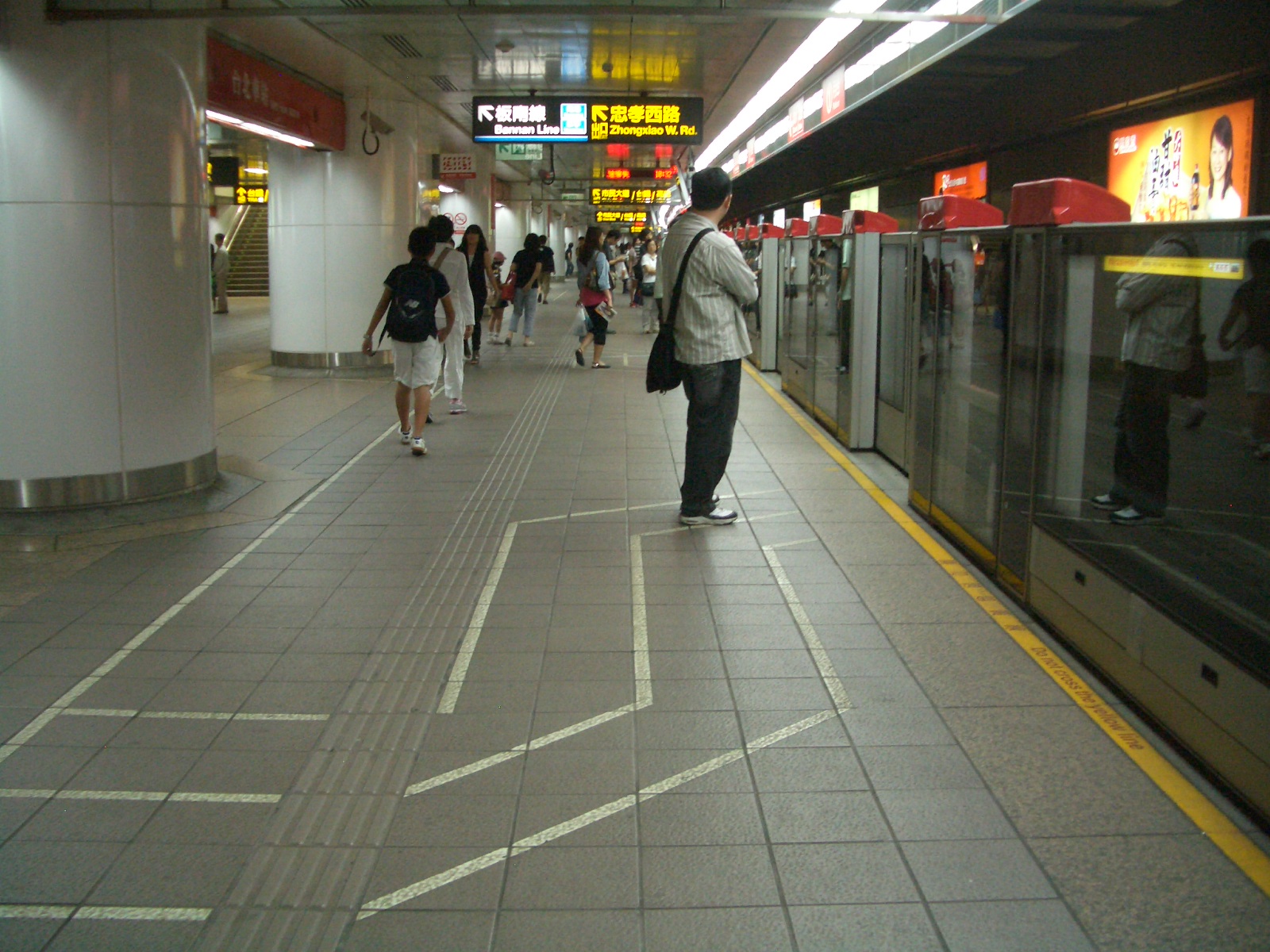
Things are different now. I was impressed by the Taipei subways a few years back when I attended the IDF conference. This time I took a few snapshots during this short visit.
To the left are photos of waiting lines for Taipei subways. Waiting lines are marked to avoid the out-going passengers. These two were the "before and after" pictures with people waiting for subway train to arrive.
Now, what ushered in the civility and good manners? Is chaos a necessary step on its way to civility? What are the necessary conditions to lead to this path? There are many places in the world today that have not gotten out of their chaos in recent memory. Why are they stuck?
Subway station signs now are in the PinYin romanization system instead of in the traditional Wade-Giles system used in the island. My name "Tzongyu Lee" would have been "Zongyu Li" in the new schema of things. But just as "Taipei" and "Tsinghua University" do not get converted to "Taibei" and "Qinghua University", my name is not going to change. The Pin-Yin system is only 50 years old, while the Wade-Giles has 150 years of history. Established names are not going to change for the sake of change and uniformity. Subway train announcements were in Mandarin Chinese, Taiwanese, English and sometimes even Hakka Chinese is heard.

Taipei scooters are popular. They offer something motorized and fast, and they are easy to park and can squeeze through the traffic.
There are many foreigners and laborers from abroad including overseas Chinese returning from North America. Foreigners are so common and often go unnoticed. Some of my friends told me that they enjoy this atmosphere of anonymity, and do not have to worry about being cheated one way or the other.
I took the opportunity to visit Danshui (Tamsui) via subway after I took care of some personal business.
Danshui is situated at the mouth o f the Danshui River on the northwestern side of Taipei. I bought the ferry ticket pack to Bali (across the river) first, to Fisherman's Wharf next, and back to the old town for 120 Taiwan Dollars ($4 USD).
To the left is the Bali ferry terminal with Mount Goddess of GuanYin (Goddess of Mercy) in the background. I rented a bike for a short round-trip 6 miles ride to visit the ShiSanHang (Thirteen-Shops) Archeological Museum.
The distance is not far, but the scorching heat with stifling humidity was hard to bear.
 The museum is right next to a waste water treatment plant. The plant is actually housed in 6 giant jars. I thought they were the ThirteenShop Archeological Musuem at first because of their artistic design ;-)
The museum was designed with Italy's leaning tower of Pisa in mind, from the look of its main building. It has some interesting artifacts and history. The material dated way back, much earlier than 1600's Dutch Formosa, which was quite interesting to me.


My last stop was the Danshui Fisherman's Wharf, which offered a nice boardwalk and a relaxing atmosphere. It was quite commercialized, though.
I learned to stay indoors next day because of the heat. I ended up finding a nice exhibition on the "Legends of Heroes - the Heritage of the Three Kingdoms Era" in Taipei's National Museum of History. This turned out to be a surprisingly nice visit. It had a good collection of paintings, crafts, artifacts, stone rubbings, and so on from many different museums in China.
I happen to be listening to the story-telling version of the MP3 "The Romance of Three Kingdoms" on and off during my travels in the last year or so. It was really a treat to me to see this exhibit in one place, with some level of analysis between history and legends.
I grew up in this metropolitan city until I graduated from college. Then I went "abroad" to study, which led eventually to my emigration to the United States. I remember that when the economy started to take off in Taiwan forty years ago, the traffic was a me
 ss and people were crowding up everywhere with no waiting lines or signs of civility anywhere.
Things are different now. I was impressed by the Taipei subways a few years back when I attended the IDF conference. This time I took a few snapshots during this short visit.
To the left are photos of waiting lines for Taipei subways. Waiting lines are marked to avoid the out-going passengers. These two were the "before and after" pictures with people waiting for subway train to arrive.
Now, what ushered in the civility
 and good manners? Is chaos a necessary step on its way to civility? What are the necessary conditions to lead to this path? There are many places in the world today that have not gotten out of their chaos in recent memory. Why are they stuck?
Subway station signs now are in the PinYin romanization system instead of in the traditional Wade-Giles system used in the island. My name "Tzongyu Lee" would have been "Zongyu Li" in the new schema of things. But just as "Taipei" and "Tsinghua University" do not get converted to "Taibei" and "Qinghua University", my name is not going to change. The Pin-Yin system is only 50 years old, while the Wade-Giles has 150 years of history. Established names are not going to change for the sake of change and uniformity. Subway train announcements were in Mandarin Chinese, Taiwanese, English and sometimes even Hakka Chinese is heard.

Taipei scooters are popular. They offer something motorized and fast, and they are easy to park and can squeeze through the traffic.
There are many foreigners and laborers from abroad including overseas Chinese returning from North America. Foreigners are so common and often go unnoticed. Some of my friends told me that they enjoy this atmosphere of anonymity, and do not have to worry about being cheated one way or the other.
I took the opportunity to visit Danshui (Tamsui) via subway after I took care of some personal business.
Danshui is situated at the mouth o
 f the Danshui River on the northwestern side of Taipei. I bought the ferry ticket pack to Bali (across the river) first, to Fisherman's Wharf next, and back to the old town for 120 Taiwan Dollars ($4 USD).
To the left is the Bali ferry terminal with Mount Goddess of GuanYin (Goddess of Mercy) in the background. I rented a bike for a short round-trip 6 miles ride to visit the ShiSanHang (Thirteen-Shops) Archeological Museum.
The distance is not far, but the scorching heat with stifling humidity was hard to bear.
 The museum is right next to a waste water treatment plant. The plant is actually housed in 6 giant jars. I thought they were the ThirteenShop Archeological Musuem at first because of their artistic design ;-)
The museum was designed with Italy's leaning tower of Pisa in mind, from the look of its main building. It has some interesting artifacts and history. The material dated way back, much earlier than 1600's Dutch Formosa, which was quite interesting to me.


My last stop was the Danshui Fisherman's Wharf, which offered a nice boardwalk and a relaxing atmosphere. It was quite commercialized, though.
I learned to stay indoors next day because of the heat. I ended up finding a nice exhibition on the "Legends of Heroes - the Heritage of the Three Kingdoms Era" in Taipei's National Museum of History. This turned out to be a surprisingly nice visit. It had a good collection of paintings, crafts, artifacts, stone rubbings, and so on from many different museums in China.
I happen to be listening to the story-telling version of the MP3 "The Romance of Three Kingdoms" on and off during my travels in the last year or so. It was really a treat to me to see this exhibit in one place, with some level of analysis between history and legends.
Tuesday, August 3, 2010
Colonel Sanders is very popular in China
I had a 2-week business trip in the second half of July and could not help but write about this KFC phenomenon.
KFC is a yuppie place in China. It carries status and often is a favorite place for young people to meet. You can search on "KFC in China" and find many interesting write-ups and observations of this incredibly vibrant fast-food chain, which is uninteresting in the United States.
A book wit h this as the title can be found at Amazon.com.
To the left is a snapshot of the ordering line in Beijing's WangFuJing shopping district in late July 2010. The hustle and bustle is an envious for any business.

Colonel Sanders and his sepia pictures of the young and old times are familiar scenes in many of the KFC restaur ants in China. I can only remember seeing one such display in the United States.

KFC is innovative in its product lines for the China operations. In addition to the traditional Kentucky fried chicken, nuggets, and fish burger, it offers traditional Chinese breakfast like rice porridge and fried double-twisted dough. There are other new ideas and inventions in drinks and burger/bread packaging, and ingredients. Small, popcorn-shaped fried chicken nuggets packaged in a popcorn container is one of the new inventions I like.

KFC does a great marketing job, including this Beijing subway line 2 advertisement in the connecting pathways.
KFC is a yuppie place in China. It carries status and often is a favorite place for young people to meet. You can search on "KFC in China" and find many interesting write-ups and observations of this incredibly vibrant fast-food chain, which is uninteresting in the United States.
A book wit
 h this as the title can be found at Amazon.com.
To the left is a snapshot of the ordering line in Beijing's WangFuJing shopping district in late July 2010. The hustle and bustle is an envious for any business.

Colonel Sanders and his sepia pictures of the young and old times are familiar scenes in many of the KFC restaur
 ants in China. I can only remember seeing one such display in the United States.
KFC is innovative in its product lines for the China operations. In addition to the traditional Kentucky fried chicken, nuggets, and fish burger, it offers traditional Chinese breakfast like rice porridge and fried double-twisted dough. There are other new ideas and inventions in drinks and burger/bread packaging, and ingredients. Small, popcorn-shaped fried chicken nuggets packaged in a popcorn container is one of the new inventions I like.

KFC does a great marketing job, including this Beijing subway line 2 advertisement in the connecting pathways.
Subscribe to:
Posts (Atom)
